

Dollar jumps again ahead of pivotal PCE data

Jamie Dutta >
Market Analyst
Jamie Dutta >
Market Analyst
Jamie Dutta is a Market Analyst for Vantage. He comes with extensive experience as a full-time trader and financial market commentator, having worked as a trader in top tier investment banks and trading houses.

* US Q2 GDP revised higher to 3.8% from 3.3% and estimated 3.3%
* Buck rises again against its peers after strong US economic data
* Wall Street finish lower as uncertainty over rate cut outlook continues
* GBP hits 7-week low as investors weigh UK politics and fiscal risks
FX: USD jumped to a more than three-week high as bulls built on Wednesday’s upside move. US data broadly painted a solid economic picture while the mass of dollar shorts were squeezed. Q2 GDP was revised higher and weekly jobless claims tumbled again after the recent spike. All eyes are on the Core PCE figures. Cautious comments on Fed policy outlook from Powell and Goolsbee this week may be overshadowing the more dovish leanings of Miran and Bowman to pare Fed easing bets slightly. There are now around 38bps of cuts priced in for this year and the final two FOMC meetings next month and in December. That means now it’s just above a coin flip for a second quarter point move in December, with October still nailed on.
EUR fell to its 50-day SMA at 1.1677 and the midpoint of the August to September rally at 1.1655. German-US yield spreads still appear supportive of the euro, but the dollar is enjoying a good week after its bullish rejection of multi-year lows after last week’s fed meeting. The SNB kept rates unchanged as expected and FX guidance was repeated. The CHF very modestly outperformed its peers.
GBP broke down to its early September lows around 1.3332 as it posted 7-week lows. Stories circulated around a potential leadership challenge to PM Starmer which caused gilts to sell off and yields surge. Markets remain concerned about the UK’s fiscal situation and are focused on headlines heading into the Autumn Budget on November 26. The hawkish BOE may get trumped by domestic politics and very tough choices faced by Chancellor Reeves.
JPY weakened as the major continued to move further away from the 200-day SMA at 148.45. The cycle highs from the start of August at 150.91 are nearby after today’s strong close. Politics are also a strong focus in Japan as we have highlighted this week, ahead of the LDP leadership election next Saturday. We had comments from former BoJ officials who hinted at the possibility of a hike as soon as October.
AUD fell sharply but found support at its 50-day SMA at 0.6538. Markets continued to digest strong CPI data with some local media reports pointing to RBA hikes. CAD softened again for a fourth straight day as it topped the most recent cycle high in late August. The four-month highs in the major see bulls aiming for the May peaks around 1.40, where the 200-day SMA also lies.
US stocks: The S&P 500 lost 0.50% to close at 6,605. The Nasdaq moved lower -0.43% to settle at 24,397. The Dow Jones finished at 45,947, down 0.38% while small caps underperformed with the Russell 2000 off 0.98% at 2,411. Only two sectors bucked the negative mood with Energy again leading (+0.87%) and Tech just about in the green (+0.03%). Healthcare, Consumer Discretionary and Materials led the losers, all down more than 1%. Intel jumped another 8.8% as it hit levels last seen in July 2024. The stock is heavily overbought and pushed above its 200-week SMA. The last time it was above this was back in January 2024. The company has approached Apple about a potential investment to support its turnaround. The latter closed up 1.8%. Meta is reportedly set to face a charge sheet from the EU for failing to adequately police illegal content, risking fines. The stock finished down 1.54%.
Asian stocks: Futures are mixed. Stocks traded mixed with a lack of big catalyst and a soft Wall Street showing. The ASX 200 eased initially on the gold pull back but energy strength helped. The Nikkei 225 moved between gains and losses with support around 45,500. The Hang Seng and Shanghai Comp were choppy, with both indices initially trimming their modest opening gains before rebounding modestly.
Gold consolidated its recent rally as bullion printed an inside day. That means all the day’s trading was contained ‘inside’ the prior day’s range. This month’s 10% move higher inevitably has seen some profit taking ahead of Friday’s key inflation data. Fed rate cut bets have also been reined in with stronger US data and more cautious Fedspeak significant this week.
Day Ahead – Tokyo CPI, US Core PCE
This leading indicator for national CPI is forecast to tick up two-tenths to 2.8% in August. The impact of rising food prices is set to cool. But sticky core inflation is being driven by demand-side pressure.
The US Core PCE figure, the Fed’s favoured inflation gauge, is expected to rise 0.2% m/m and 2.9% y/y. This comes despite a stronger 0.35% increase in core CPI in August. However, that included a bigger rise in housing prices which receive a much smaller weight in PCE than in CPI. The FOMC’s most recent median forecast saw the reading at 3.1% in December 2025, but cooling to 2.6% next year.
The pivot towards the employment side of the dual mandate was reiterated at last week’s meeting. Recent Fedspeak has been mixed with more question marks about overly frontloading rate cuts. Indeed, Chicago Fed’s Goolsbee said that he was uncomfortable “on the presumption that inflation will probably just be transitory and go away”.
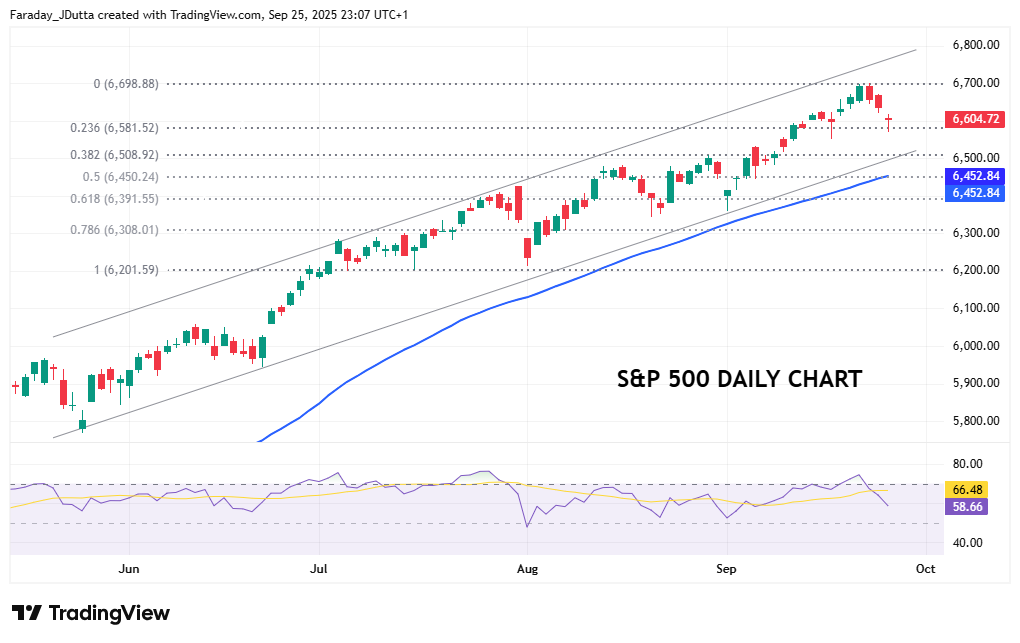
Chart of the Day – “Wall of worry” slows S&P 500 bull run
The benchmark broad-based major US index has enjoyed five straight months of gains, after the spike low over the Liberation Day events. So far, September has not lived up to its reputation as a big down month with the recent three-day correction a mere blip in the long-term bull channel. That series of higher highs and higher lows still appears strong after the index recently overbought alarms on several indicators. Investors are now looking at a run into the end of the year that typically delivers a return of more than 5% on average from October to December.
Volatility (VIX) remains below its long-term average and is low generally across stocks and bonds, with broader FX volatility the lowest since mid-2024. But traders have climbed a ‘wall of worry’ amid an environment of complacency amid high equity valuations, elevated geopolitical risks and increased uncertainty over the pace of Fed easing. The first Fib retrace level (23.6%) of the July to September rally sits at 6,581 which we tapped yesterday. The next major Fib (38.2%) level is at 6,508, around where the bottom of the bull channel sits.