


 Updated
Across empires, economic cycles, and modern markets, gold has stood as a universal symbol of enduring value and stability. For those seeking to preserve their purchasing power and hedge against inflation, deciding to invest in gold remains a cornerstone financial strategy.
Today, this precious metal is far more than just a historical commodity—it is a trusted safe-haven asset. Allocating gold for investment purposes is a popular way to diversify portfolios and ensure long-term wealth preservation during periods of market volatility.
Understanding the unique characteristics of this market can help you determine exactly how to buy gold for investment. Whether you prefer the tangible security of buying gold coins for investment or the modern flexibility of ETF gold investing, learning about your options is the crucial first step.
Ultimately, for anyone looking to invest in gold effectively, exploring these different avenues will empower you to make the most informed decisions for your portfolio.
The Value of Investing in Gold
Gold’s value extends far beyond its aesthetic appeal in jewellery. To truly understand why people choose to invest in gold, we have to look at its unique combination of physical utility, historical significance, and financial resilience.
Intrinsic Value and Rarity
First, gold possesses undeniable intrinsic value. Thanks to its high conductivity and resistance to corrosion, it plays a crucial role in key industries like electronics, aerospace, and medical technology. Because mining new reserves is increasingly difficult and expensive, gold remains a finite natural resource. This scarcity inherently supports its use as gold for investment.
A Historical and Modern Financial Pillar
Long before modern financial systems, people were buying gold coins for investment and trade, with their use as currency dating back over 6,000 years. When societies evolved to paper money, gold anchored the financial system under the Gold Standard 1.
Even today, in a world of fiat currencies, central banks continue to hold substantial gold reserves to safeguard against inflation and currency fluctuations. This reinforces its enduring status as a premier global reserve asset.
Resilience in Volatile Markets
This financial resilience remains highly visible. In 2026, gold reached record highs, driven by expectations of U.S. Federal Reserve rate cuts and renewed US-China trade tensions 2. During macroeconomic headwinds like these, gold price investing becomes increasingly attractive, as the metal acts as a defensive asset when confidence in traditional currencies wavers.
Gold vs. Equities: A Matter of Timing
When deciding to buy gold for investment, candour about its performance is important: it is not always a bed of roses. Over longer timeframes, gold tends to underperform equities during strong bull markets.
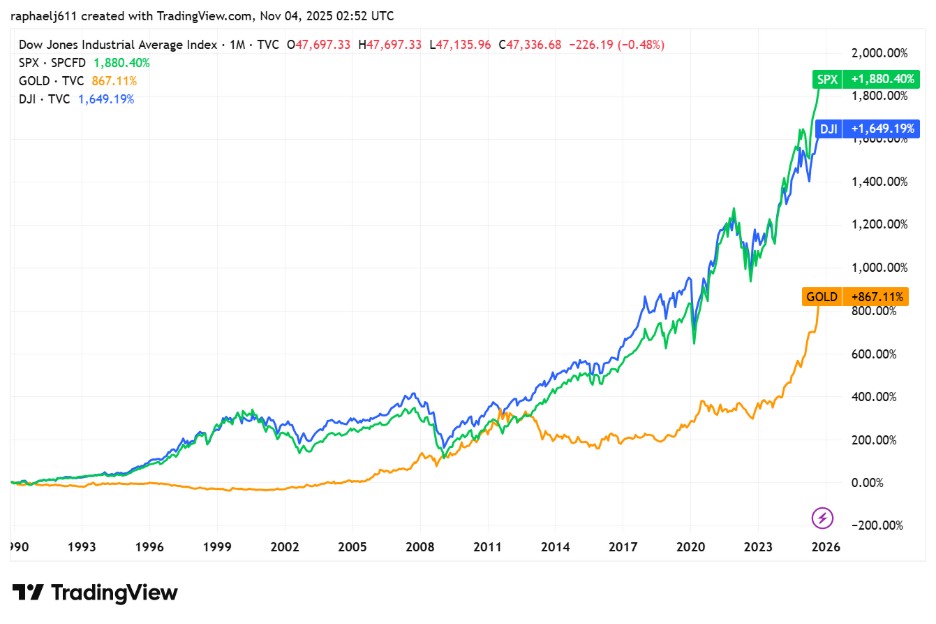
The 30-Year View (Chart 1): Over the past 30 years, major indices like the S&P 500 and the Dow Jones (blue and green lines, respectively) have delivered higher cumulative returns than gold (orange line), driven by sustained economic expansion and corporate earnings growth through the 1990s and 2010s.
That said, the picture changes when the timeframe shifts.
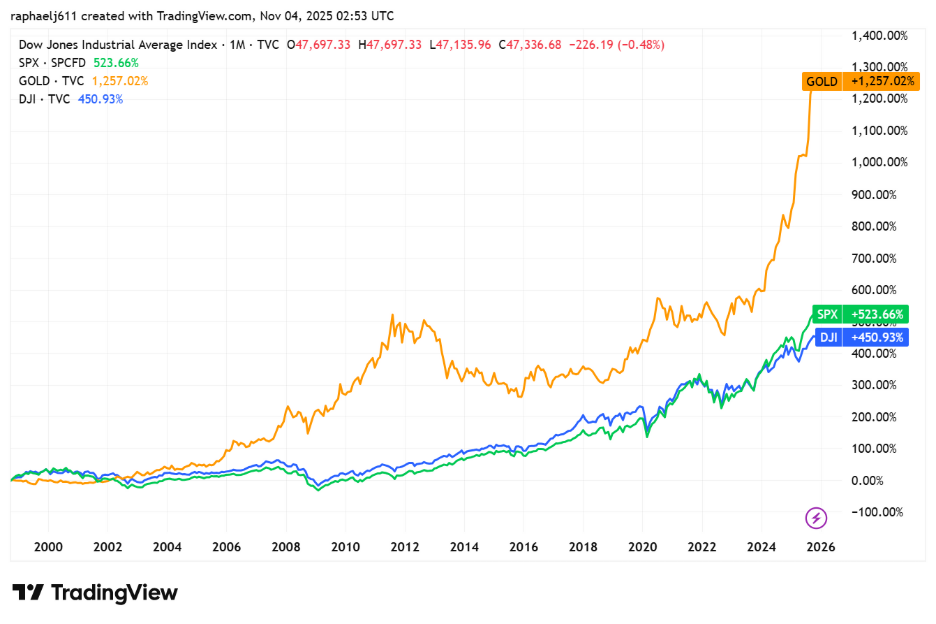
The 20-Year View (Chart 2): However, the picture changes when the timeframe shifts. Starting from 2000, those who decided to invest in gold saw the precious metal outperform major stock indices. It shone during the 2001 tech bubble burst, the 2008 financial crisis, and the 2020 COVID-19 pandemic.
Think of gold as the anchor that steadies the ship when markets turn rough.
Many investors consider this stability an important characteristic of gold. While gold doesn’t generate income like stocks or bonds, it is often viewed as a store of value and a potential hedge during periods of market or currency volatility, helping diversify exposure to higher-risk assets.
Why Do Investors Like Gold, Especially in 2026?
While gold’s appeal has evolved over centuries, its role in a modern portfolio remains absolutely distinctive. Today, investors are drawn to the precious metal for its unmatched liquidity, powerful diversification benefits, and rock-solid store-of-value qualities.
Liquidity
Here is the truth: gold is one of the most liquid assets in the world.
Whether you are trading through exchanges, banks, or authorised dealers, you can typically move in and out of positions within very short timeframes. This high level of market accessibility gives you ultimate flexibility when adjusting your portfolio allocations or managing sudden cash needs.
The Power of Diversification
Gold’s price movements often have a low or even negative correlation with traditional risk assets like equities.
Think about it: when stock markets wobble, gold often acts as a counterbalance. Including gold for investment as part of a broader mix of assets is a way to smooth out your portfolio’s performance over time and reduce your exposure to single-market risks during times of extreme stress.
A Historic Store of Value
Unlike fiat currencies that slowly lose their purchasing power to inflation, gold has maintained its value over extended periods.
In fact, with global debt concerns, shifting monetary policies, and geopolitical tensions remaining hot topics this year, its enduring role as a tangible asset and global medium of exchange makes the decision to invest gold a highly popular choice across both developed and emerging markets.
Impressive Returns in the Right Climate
While it isn’t specifically designed to outperform aggressive growth assets, gold has historically delivered periods of incredible performance during times of high inflation, economic uncertainty, or low real interest rates.
What does this mean for you? Over the past two decades—and notably surging to historic highs around the $5,000 per ounce mark in early 2026—gold prices have risen substantially. Whether you are figuring out exactly where to invest gold physically or exploring modern, highly liquid avenues like ETF gold investing, the yellow metal continues to prove its relevance as a crucial component of a diversified portfolio for the modern investor.
How to Invest in Gold: Explore These 5 Ways
There are many ways to gain exposure to gold, depending on your investment goals, experience, and preferred level of involvement. From holding physical bullion to trading contracts for difference (CFDs), each approach carries different costs, risks, and liquidity considerations. Let’s dive in:
1. Physical Gold (Bullion and Jewellery)
Owning physical gold provides direct, tangible exposure to the precious metal itself. Bullion bars range from small, fractional sizes to 400-ounce institutional blocks, while widely recognised coins—such as the American Gold Eagle, Canadian Maple Leaf, and South African Krugerrand—offer standardised purity and global liquidity.
Buying gold coins for investment gives you an asset you can actually hold in your hand. Jewellery can also carry intrinsic value, though design mark-ups and lower purity may reduce its efficiency compared to standard bullion. If you are wondering where to buy gold for investment, the golden rule is to always verify purity and stick to accredited, reputable dealers to eliminate counterparty risks.
2. Gold CFDs
Looking for immediate action? For investors who prefer a hands-on approach and utilise technical analysis to time the markets, contracts for difference (CFDs) offer the fastest way to gain exposure to gold price movements without the hassle of physical ownership.
Through CFD brokers like Vantage, traders can instantly go long or short depending on their market outlook, offering ultimate flexibility in both rising and falling markets. Because of leverage, CFDs amplify your potential returns (and losses), making them the premier choice for experienced traders who understand margin and risk management.
For readers interested in active trading strategies, see our guide on “How to Trade Gold”.
3. Gold IRA
A gold IRA (individual retirement account) allows investors in certain jurisdictions to hold physical gold or gold-backed assets directly within a retirement portfolio. If your goal is to buy gold for investment with an eye on your twilight years, this structure can offer powerful diversification benefits and potential tax advantages.
Always review your local regulations and custodian requirements before opening an account.
4. Gold Futures
Want to trade like the pros? Gold futures are standardised exchange-traded contracts to buy or sell gold at a specified price on a future date. They are highly popular among institutional investors seeking to hedge portfolios.
However, futures are highly leveraged and often require significant upfront capital and a deep understanding of the derivatives market. For retail investors looking for similar price action with lower barriers to entry, Gold CFDs are often the more accessible alternative.
5. Gold ETFs and Mining Stocks
Want the easiest entry point? If you are figuring out where to invest gold without the hassle of a home safe or bank vault, ETF gold investing is a fantastic modern alternative. Exchange-traded funds (like GLD, GDX or IAU) offer convenient, low-cost access to price exposure. Each share typically represents a fractional interest in gold holdings and can be traded on the stock market throughout the day, just like regular shares.
Alternatively, investing in a gold mining stock provides indirect exposure driven by both gold prices and company-specific factors like production costs. Keep in mind: mining stocks generally carry higher business risks than the metal itself, and both ETFs and stocks restrict you to standard exchange trading hours.
5 Factors to Consider Before Investing in Gold
Before you allocate capital and decide to invest in gold, it’s worth understanding the core factors that influence its performance, cost, and overall suitability within a broader portfolio. From market trends to storage logistics, these considerations can help investors make informed, risk-aware decisions.
1. Market Conditions & Interest Rates
Gold’s performance is heavily shaped by broader macroeconomic factors.
For instance, the precious metal tends to perform exceptionally well when real interest rates drop, inflation expectations rise, or the US dollar weakens. Central bank policies and geopolitical developments also play a massive role in gold price investing. While it is widely perceived as a safe-haven asset, its price can still fluctuate significantly depending on these shifting global market conditions.
2. Storage & Insurance
Have you thought about logistics? If you are researching where to buy gold for investment in its physical form, you must factor in secure storage.
Whether you keep it at home in a safe, in a bank deposit box, or through a professional vaulting service, each option carries different implications for cost, convenience, and security. Allocated storage offers direct ownership of identifiable assets (perfect if you are buying gold coins for investment), while unallocated storage pools investors’ holdings and may carry counterparty risk. Don’t forget to calculate the cost of insurance, which varies widely by provider and location.
3. Taxes & Capital Gains
This part is crucial: Gold investments may be subject to unique taxation depending on your jurisdiction and the specific asset type.
Physical gold for investment, ETFs, and mining equities can each have completely different tax treatments. Before you buy gold for investment, you should review your local regulations regarding capital gains, sales taxes, and even retirement account eligibility (like a Gold IRA). It is always highly recommended to seek professional tax advice before adjusting your portfolio.
4. Investment Horizon & Goals
Let’s look at the big picture. Gold is generally used as a long-term portfolio diversifier rather than a short-term trading instrument.
It can help balance your risk during periods of high inflation or severe market stress, serving as a powerful hedge against currency depreciation. Before leaping to invest in gold, make sure you align your exposure with your broader portfolio strategy, your specific time horizon, and your personal risk tolerance.
5. Potential Returns vs. Risks
While many investors use gold for portfolio stability, it does not generate income or dividends like equities or bonds—except in cases where investors hold derivatives or structured products linked to gold that may specify a distribution under defined conditions.
Investors should weigh the potential benefits of diversification and capital preservation against the opportunity cost of holding a non-yielding asset, particularly in environments of rising interest rates or strong equity performance.
Gold vs. Other Investment Options
| Asset Class | Volatility | Income Yield | Inflation Hedge | Liquidity | Typical Use / Characteristics |
| Gold | Low to Medium | None (unless held through mining stocks, gold-lending ETFs, or certain gold-linked structured products) | Historically strong | High | Often used for diversification and defensive purposes |
| Stocks | High | Dividends | Moderate | High | Typically associated with growth and income potential |
| Cryptocurrency | Very High | None | Weak | Variable | Highly volatile; used for speculative exposure |
| Real Estate | Medium | Rental Income | Moderate | Low to Moderate | May serve as a long-term physical asset or income source |
Gold is often viewed as a defensive asset that can help balance a portfolio during periods of market stress. Rather than competing with higher-growth investments, it typically serves as a complement within a diversified strategy.
How Much Gold Should You Have in Your Portfolio?
Let’s be clear from the start: there is no universal, one-size-fits-all rule when it comes to how much gold an investor should hold.
The appropriate allocation depends entirely on your personal investment objectives, risk tolerance, time horizon, and overall portfolio composition.
So, what do the experts say?
Many financial analysts and portfolio strategists suggest allocating around 2% to 10% of a diversified portfolio to gold for investment or other precious metals. This helps you manage risks related to sudden inflation, currency depreciation, and unexpected market volatility³.
Reflecting a highly bullish stance, Jeffrey Gundlach, the founder and CEO of DoubleLine Capital, has previously remarked that a massive 25% allocation to gold is “not excessive” given the context of US dollar weakness and rapidly shifting global currency dynamics4.
Keep in mind: this reflects one professional’s aggressive viewpoint during a specific macroeconomic climate, and it is not a blanket recommendation for everyone deciding to invest in gold.
The Pros and Cons of Investing in Gold
| Pros | Cons |
| High Liquidity | Limited or No Income Generation |
| Potential Hedge Against Inflation | Can Underperform During Bull Markets |
| Low Correlation With Stocks | Storage and Insurance Costs |
| Tangible, Globally Recognised Asset | Price Volatility in the Short Term |
Is Now a Good Time to Invest in Gold?
Gold’s 2026 outlook remains structurally bullish, driven by shifting monetary policies, geopolitical uncertainty, and relentless global demand.
The US Federal Reserve has signalled a more accommodative stance, with potential rate cuts expected over the coming year 5. Lower interest rates tend to reduce real yields, which makes non-income-generating assets incredibly appealing for those looking to buy gold investments.
Historically, monetary easing triggers strong precious metal performance because investors seek alternative stores of value.
Geopolitical tensions and trade frictions—particularly involving major economies such as the US and China—continue to drive safe-haven demand. Simultaneously, central banks, especially in emerging markets, have been increasing their gold holdings 6.
While short-term volatility is normal, the long-term environment strongly supports those deciding to invest in gold as a bulletproof hedge against economic unpredictability. Whether you are exploring exactly how to buy gold for investment via physical bullion or prefer the modern liquidity of ETF gold investing, it remains a vital component for a diversified portfolio.
For timely insights into market trends and more, visit Vantage Academy’s Market News & Analysis.
Example: How Gold Investment Works
Imagine an investor allocated $1,000 in gold in 2015, when prices averaged around $1,150 per ounce. A decade later, gold trades above $2,400 per ounce, roughly doubling the nominal value of that investment 7.
This illustrates how gold has historically acted as a potential store of value during a period marked by economic uncertainty, including the COVID-19 pandemic and ongoing trade tensions.
However, gold’s performance has not always been linear. Between 2012 and 2015, for example, gold prices fell by nearly 40% as the US dollar strengthened and expectations of higher interest rates reduced the precious metal’s appeal 8. The Federal Reserve’s decision in 2014 to end its post-2008 stimulus programme also contributed to weaker sentiment towards gold 9.
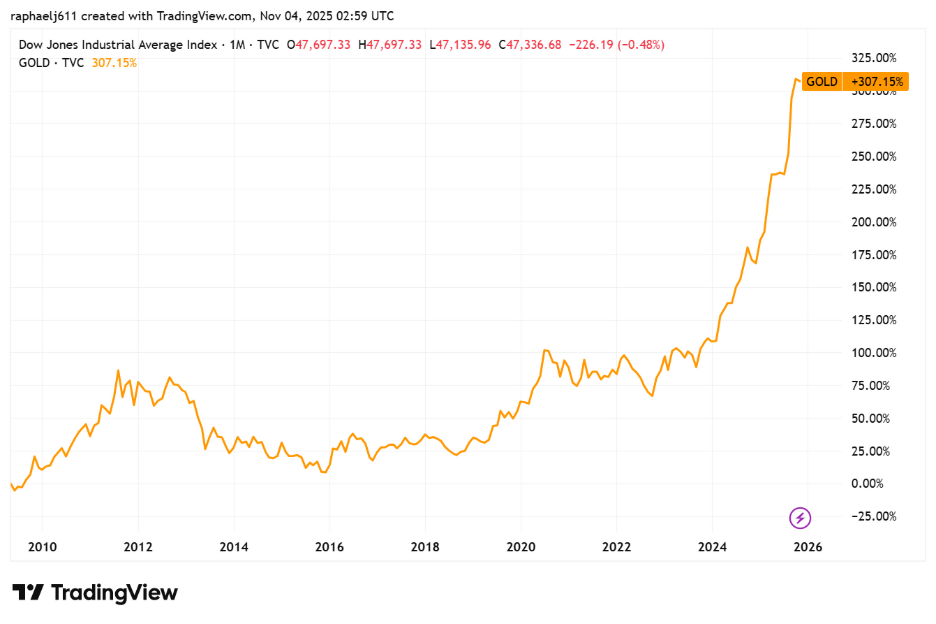
These fluctuations highlight the importance of viewing gold as a long-term portfolio diversifier, not a tool for quick profits. Over time, gold has often shown a tendency to offset declines in risk assets and may benefit patient investors who use it to balance portfolio risk rather than pursue rapid gains.
3 Key Risks When Investing In Gold
Like any asset class, choosing to invest in gold carries certain risks. However, understanding these factors is the key to positioning your portfolio for success.
1. Price Volatility
Gold prices fluctuate based on macroeconomic shifts, interest rates, and global sentiment. While sudden currency weakness can trigger sharp rallies, prices can also consolidate. However, in 2022, gold rose despite a higher policy rate, supported by strong central-bank purchases and safe-haven flows10.
The Solution: This volatility is exactly why many active traders prefer gold CFDs. Instead of just holding and hoping the price goes up, CFDs allow you to go long or short, giving you the flexibility to capitalise on market movements in both directions.
2. No Yield or Passive Income
Unlike dividend-paying equities or high-yield bonds, physical gold and most gold-backed ETFs do not produce passive income. Your returns depend entirely on price appreciation.
If your goal is active capital growth rather than passive holding, trading gold via CFDs allows you to actively capture value from daily and weekly price swings, rather than waiting years for physical appreciation.
3. Storage and Insurance Costs
Here is the hidden cost of physical gold: owning bullion requires secure storage and insurance. Professional vaulting can cost around 0.5% annually, quietly eroding your returns over time11.
If you do not want these logistical headaches, digital assets or CFDs completely remove the need for physical safekeeping, vaulting fees, and insurance premiums.
Why Gold Remains a Frontier Worth Exploring
Gold’s enduring appeal lies in its ability to remain relevant across generations of investors. While currencies and asset classes evolve over time, gold continues to hold significance as a globally recognised store of value and a potential safe-haven asset during times of uncertainty.
Investors don’t need to view gold as a replacement for growth assets but rather as a complement that can enhance diversification and resilience. By incorporating gold thoughtfully within a balanced portfolio, investors may be better positioned to navigate periods of market stress and preserve long-term purchasing power.
Interested in gaining exposure to gold? Open a live account with Vantage today to explore gold CFDs (XAU/USD) and access global markets with flexible position sizing.
References
- “The Many Uses of Gold – Geology.com”. https://geology.com/minerals/gold/uses-of-gold.shtml. Accessed 13 November 2025.
- “Gold Sets New Record Peak – TradingView”. https://www.tradingview.com/news/te_news:492707:0-gold-sets-new-record-peak/. Accessed 13 November 2025.
- “How Much Gold Should I Hold In My Investment Portfolio? – Dollars and Sense”. https://dollarsandsense.sg/how-much-gold-investment-portfolio/ .
- “Jeffrey Gundlach on Fed Divisions, Overeasing and Global Opportunities – YouTube”. https://www.youtube.com/watch?v=2npB_iPGbz4. Accessed 10 November 2025.
- “The Fed Is Forecast to Cut Rates in December as Employment Cools – Goldman Sachs”. https://www.goldmansachs.com/insights/articles/the-fed-is-forecast-to-cut-rates-in-december-as-employment-cools. Accessed 10 November 2025.
- “Central bank gold statistics: Central bank gold buying rebounds in August – World Gold Council”. https://www.gold.org/goldhub/gold-focus/2025/10/central-bank-gold-statistics-central-bank-gold-buying-rebounds-august. Accessed 10 November 2025.
- “If you’d invested $1,000 in gold 10 years ago, here’s how much you’d have now – Bankrate”. https://www.bankrate.com/investing/gold-investment-worth-now/. Accessed 13 November 2025.
- “Gold price falls to five-year low on US rate rise talk – BBC”. https://www.bbc.com/news/business-33590480. Accessed 13 November 2025.
- “US Federal Reserve ends quantitative easing stimulus program with economic recovery on track – ABC News”. https://www.abc.net.au/news/2014-10-30/fed-ends-quantitative-easing-stimulus-program/5852666. Accessed 13 November 2025.
- “Driving effects of U.S. monetary policy and geopolitical risks on gold reserve share – International Review of Financial Analysis”. https://www.sciencedirect.com/science/article/abs/pii/S1057521925004788. Accessed 13 November 2025.
- “Gold Storage: How Much Does It Cost To Store Gold – International Depository Services Group”. https://internationaldepositoryservices.com/blog/gold-storage-how-much-does-it-cost-to-store-gold/. Accessed 13 November 2025.