


 Updated
A trader closes a winning position five minutes early, certain the price is about to turn. But it doesn’t turn, and that single decision—driven by fear, not by strategy—illustrates exactly why trading psychology for beginners starts with the mindset, not the market.
Trading psychology covers the mental and emotional side of trading: A trader’s mindset, biases, and how they react under pressure. This guide covers the key elements behind that behaviour, why so many traders struggle with it, and five practical ways to build discipline.
Take note that none of this replaces a trading plan or risk management; it works alongside both.
Key Points
- Trading psychology shapes outcomes. Fear, greed, and bias can distort decisions regardless of how sound the underlying strategy is.
- Five elements do most of the damage: Fear, greed, overconfidence, impulsiveness and confirmation bias.
- Behaviour drives a measurable performance gap as independent research links emotion-led decisions to underperformance versus the market itself.2
- CFD trading raises the stakes because leverage magnifies both potential gains and potential losses, which can sharpen emotional reactions to price moves.
- Improvement is a process, not an event because discipline and self-awareness build up over time, not overnight.
- Tools like journaling and risk management help support the mindset but don’t replace it.
What Is Trading Psychology?
Trading psychology refers to the mental and emotional state of a trader—their mindset, beliefs, biases, and how they behave under pressure. It shapes decisions from position sizing to when a trade gets closed.
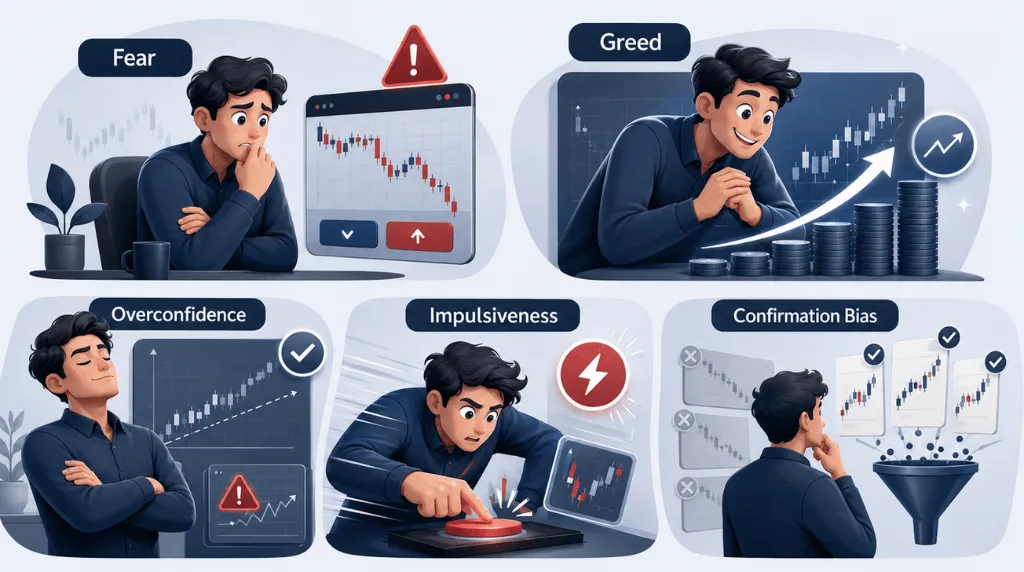
During live trading, psychological roadblocks such as fear, greed, overconfidence, impulsiveness, and confirmation bias surface often. Left unmanaged, they lead to irrational decisions, avoidable errors, and losses in capital.
This matters as much in CFD trading as in traditional investing, arguably more, since leverage means the emotional weight of a single decision is amplified in both positive and negative directions.
Building awareness of these short-term pitfalls is what allows traders to develop strategies that hold up under real market pressure, not just on paper.
What Are the 5 Key Elements of Trading Psychology?
Five recurring emotional patterns account for most of the damage trading psychology does to a trader’s account. Each emotion is worth recognising on its own.
1. Fear
Fear shows up as hesitation, early exits, and reluctance to enter otherwise sound trades. A trader who has just taken a loss often becomes more cautious on the next setup, even when the two trades have nothing in common. Left unmanaged, fear can lead to closing winning positions too early and missing valid entries altogether.
2. Greed
Greed is the drive for larger and faster returns than a strategy or risk plan allows for. It usually shows up as oversized positions, ignoring stop-losses, and holding on to losing trades in the hope the market reverses.
Greed and fear often trade places within the same session, which is part of what makes trading psychology hard to master.
3. Overconfidence
A run of winning trades can convince a trader their edge is stronger than it is. Overconfidence shows up as increased position sizes after a win streak, and skipping the research or checklist that produced the win in the first place.
4. Impulsiveness
Impulsive trades are often entered without reference to a plan, often in reaction to a headline, a chart pattern, or simply boredom. They bypass whatever risk management would normally apply, which is why they can carry disproportionate risk relative to planned trades.
5. Confirmation Bias
Confirmation bias is the tendency to notice information that supports a trade already taken and dismiss information that contradicts it. It can keep traders in losing positions longer than a neutral read of the same data would justify.
Vantage Pro Tip: Log the emotion behind each trade, not just the entry and exit price. Patterns in fear, greed, or overconfidence usually show up in the log before they show up in the account balance.
Why Do So Many Traders Struggle with Trading Psychology?
European regulators have found that between 74% and 89% of retail investor accounts lose money trading contracts for difference (CFDs), a range gathered across national competent authorities and used as the basis for the standardised CFD risk warning traders see today.1
Source: Vantage Markets
The practical implication: Strategy alone doesn’t protect capital—execution under pressure is where much of that gap typically opens up.
Independent research outside the CFD space tells a similar story. DALBAR’s annual analysis of investor behaviour has tracked a persistent gap between market index returns and what the average investor actually earns, driven largely by poorly timed, emotion-led decisions such as selling into downturns and chasing rallies after they’ve already run.2 The pattern holds across asset classes: The mechanics of a trade matter less than the discipline behind the decision to take it, or not.
None of this means trading psychology is impossible to manage. Instead, it highlights that it has to be managed deliberately, the same way a trading strategy or a risk limit does.
For a look at how psychology plays out at the market level rather than the individual level, read Vantage Markets’ guide on the psychology of market reaction.
What Are 5 Practical Ways to Improve Trading Psychology?
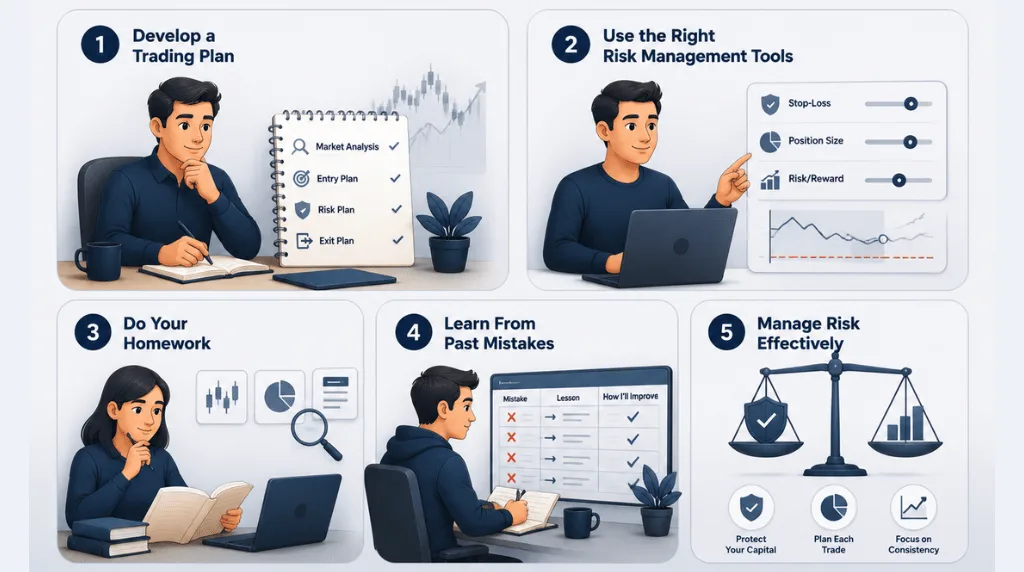
Improving trading psychology is an ongoing process that requires self-awareness, discipline, and continued learning. Vantage Markets shares five habits that support it.
1. Develop a Trading Plan
A well-defined trading plan, with clear objectives, risk management rules, and a set of entry and exit criteria, is designed to give traders the foundation for staying disciplined and avoiding impulsive decisions.
2. Use the Right Risk Management Tools
Indicators, stop-losses, and pip calculators are examples of tools traders typically keep on hand to manage a position objectively rather than emotionally.
3. Do Your Homework
In-depth research on financial instruments and markets builds the confidence that reduces impulsive decisions. Vantage Markets offers free weekly webinars for traders working on this.
Vantage Markets’ market analysis articles can be a second research option, covering market updates for traders of any experience level.
4. Learn From Past Mistakes
Rather than getting disheartened by a loss, treat it as a data point. Analysing what went wrong and adjusting the plan helps prevent the same mistake twice. A trading journal that logs decisions—not just outcomes—is one of the more effective ways to do this systematically.
5. Manage Risk Effectively
Effective risk management protects capital over the long run. Consider your own risk tolerance and limit how much capital any single position exposes to the market. Read Vantage Markets’ risk management techniques guide for more details.
Traders should also prioritise brokers that offer negative balance protection as a safeguard. At Vantage Markets, your account is protected against the rare instances where a balance falls into negative territory, so you never lose more than your deposited funds—an automated system resets the balance and adjusts credits without manual intervention.
What Are Some Recommended Trading Psychology Books for Beginners?
A handful of books are consistently recommended for traders working on their trading psychology:
- Trading in the Zone by Mark Douglas: A foundational text on the mental discipline required to follow a trading plan consistently.
- Trade Your Way to Financial Freedom by Van Tharp: Focuses on position sizing and the psychology behind risk-taking.
- The Daily Trading Coach by Brett Steenbarger: Short, practical exercises aimed at traders working on discipline day to day.
- Market Mind Games by Denise Shull: Applies behavioural psychology directly to real-time trading decisions.
Note: These are educational resources and are not meant to be a substitute for a trading plan or independent financial advice.
Building a Trading Mindset That Lasts
Trading psychology is as important to master as technical or fundamental analysis, not a secondary skill. The traders who last are usually the ones who treat their own reactions as part of the risk they’re managing, not separate from it.
Improving trading psychology doesn’t guarantee better results as no approach to trading does. But it can help to remove some of the most avoidable, self-inflicted losses.
You can open a Vantage Demo Account to practise trading psychology on live pricing without risking capital, or a Vantage Live Account if you choose to trade CFDs with real funds. CFDs carry a high risk of loss, so only trade with capital you can afford to lose.
FAQs
What does trading psychology mean?
Trading psychology refers to the mental and emotional side of trading: A trader’s mindset, biases, and how they behave under pressure, particularly during losses or unexpected volatility. It covers well-documented emotion-based patterns such as fear, greed, overconfidence, impulsiveness, and confirmation bias. Unlike a trading strategy, it isn’t written down in a plan, which is exactly why it’s easy to overlook. Most traders only notice it once a pattern of costly decisions becomes hard to ignore.
Is trading really 90% psychology?
There’s no single verified figure for this, and treating it as a literal statistic misses the point. What research does show is that behaviour—not just strategy—drives a measurable gap between market returns and what individual traders and investors actually earn. Strategy, risk management, and psychology work together, and none of the three fully compensates for weaknesses in the other two.
Framing psychology as most of the job is a useful reminder to take it seriously, not a number to build a strategy around.
Why do many traders lose money?
Regulatory data from European authorities shows that between 74% and 89% of retail investor accounts lose money trading CFDs, a range gathered across providers and used in standardised risk warnings. Leverage is a significant factor, since it magnifies both gains and losses and raises the emotional stakes of every decision. Poor risk management and emotion-led decisions compound the effect, which is why trading psychology and risk management are typically addressed together. No trading approach removes the risk of loss.
Can trading psychology be learned or trained?
Yes, to a meaningful degree—self-awareness, journaling, and repetition on a demo account all build the same discipline over time. It works the way any behavioural habit does: Gradually, and with more consistency than intensity. It doesn’t happen through reading alone, which is why practising decisions under realistic conditions matters more than memorising the common pitfalls. Improvement here supports better decision-making; it doesn’t guarantee a specific trading outcome.
What does trading psychology look like in forex and CFD trading specifically?
Leverage is a key factor because a small price move can create a proportionally larger swing in account balance, which sharpens fear and greed compared with unleveraged investing. Fast-moving currency pairs and near round-the-clock markets also mean decisions often get made under more time pressure. This is why risk management tools such as stop-losses and position sizing matter as much as mindset alone.
What are some recommended trading psychology books for beginners?
Trading in the Zone by Mark Douglas is the most widely recommended starting point, focused on the discipline needed to follow a plan consistently. Trade Your Way to Financial Freedom by Van Tharp goes deeper into position sizing and risk-based decision-making. The Daily Trading Coach by Brett Steenbarger offers short, practical exercises rather than a single continuous narrative. All three trading psychology books are designed to be educational resources and not a substitute for independent financial advice.
RISK WARNING: CFDs are complex financial instruments and carry a high risk of losing money rapidly due to leverage. You should ensure you fully understand the risks involved and carefully consider whether you can afford to take the high risk of losing your money before trading.
Disclaimer: The information is provided for educational purposes only and doesn’t take into account your personal objectives, financial circumstances, or needs. It does not constitute investment advice. We encourage you to seek independent advice if necessary. The information has not been prepared in accordance with legal requirements designed to promote the independence of investment research. No representation or warranty is given as to the accuracy or completeness of any information contained within. This material may contain historical or past performance figures and should not be relied on. Furthermore estimates, forward-looking statements, and forecasts cannot be guaranteed. The information on this site and the products and services offered are not intended for distribution to any person in any country or jurisdiction where such distribution or use would be contrary to local law or regulation.
References
1. “ESMA agrees to prohibit binary options and restrict CFDs to protect retail investors – European Securities and Markets Authority” https://www.esma.europa.eu/press-news/esma-news/esma-agrees-prohibit-binary-options-and-restrict-cfds-protect-retail-investors. Accessed on 12 July 2026.
2. “DALBAR Releases 30th Annual QAIB Report – Business Wire” https://www.businesswire.com/news/home/20240411364812/en/DALBAR-Releases-30th-Annual-QAIB-Report. Accessed on 12 July 2026.