



Crude oil is one of the world’s most important commodities. As the raw material behind fuel, plastics, and many essential petrochemicals, it plays a central role in modern industry and everyday life.
But that is only part of the story.
Crude oil is also a major force in the global economy, which is why its price is closely watched by governments, businesses, and traders alike. Changes in oil prices can affect everything from inflation and production costs to market sentiment and economic outlook.
Two of the most closely watched oil benchmarks are Brent crude and West Texas Intermediate (WTI). Brent is primarily linked to North Sea oil, while WTI reflects U.S. crude and is widely tracked on the NYMEX. Because of this, WTI crude oil prices are often used as a key indicator of US oil market conditions and broader commodity trends.
In this article, we’ll explore how WTI crude oil trading works, what drives the price of WTI crude oil, how traders use tools like the WTI crude oil price chart, and the different ways to gain exposure to the market.
Key Points
- WTI crude oil, extracted primarily from the Permian Basin in the U.S., serves as a high-quality benchmark for American oil markets due to its low sulfur content and low density, making it a sought-after grade for its refining and transportation ease.
- Trading WTI crude oil involves futures contracts on the NYMEX, allowing traders to hedge against price volatility or speculate for profits, with significant price movements influenced by supply and demand, geopolitical tensions, and macroeconomic factors.
- The volatility of WTI crude oil prices, demonstrated through historical trends and predictions, underscores its sensitivity to global economic conditions and geopolitical events, offering both risks and opportunities for traders utilising various trading strategies and instruments.
What is WTI crude oil? [1,2]
WTI crude oil is the label used for crude oil that is extracted from US territory, primarily the Permian Basin. The crude oil is drilled mainly in Texas, North Dakota, and Louisiana, and refined in the Midwest and Gulf of Mexico, before arriving at Cushing, Oklahoma, for physical exchange and price settlement.
WTI is widely regarded as a high-quality crude oil because it has low sulphur content and low density. In other words, it is considered both “light” and “sweet”, which makes it easier and cheaper to refine into usable products. Because of these qualities, the price of WTI crude oil often trades at a premium to heavier or more sulphur-rich crude grades.
The high quality and geographical region of origin render WTI the ideal candidate as the prime benchmark for the American oil market. It is the underlying commodity of the New York Mercantile Exchange’s (NYMEX) oil futures contract. As a result, WTI crude oil prices are widely used as a reference point for pricing, trading, and analysing the American oil market.
Together with Brent, WTI is considered one of the two most important oil benchmarks. The difference between WTI oil prices and Brent prices is known as the Brent-WTI spread.
History of WTI crude oil [3,4]
WTI crude oil is mostly made up of crude extracted from the Permian Basin, upon which the states of Texas and New Mexico sit. Thus, to understand the history of WTI, we should take a look at the history of oil and gas in Texas.
The discovery of oil in the Permian Basin can be traced back to 1921, when a Mitchell County, Texas, discovery well in the eastern Permian opened the Westbrook field to production. But it wasn’t until 1923 when Frank T. Pickrell and Haymon Krupp drilled their Santa Rita No. 1 oil rig near Big Lake, Texas, that the true beginning of the oil boom in the Permian Basin began.
During the 1930s, oil production in the Permian Basin continued at high levels, even through the challenges created by the Great Depression. In fact, a record 92 million barrels were produced in 1938, making the Permian Basin the largest oil-producing region in the United States.
The onset of World War II saw a spike in demand for oil, bringing the spotlight back to the Permian Basin. Post-war, the region saw significant growth, thanks to new technology and seismic surveys that could identify and extract oil and gas reserves that were previously inaccessible.
By the 1950s, the Permian Basin saw its first peak, with production levels exceeding previous levels. However, from the 1960s to the 1980s, major oil companies began their exodus from the Permian and other US oil plays, in favour of offshore and overseas fields instead. The 1970s also saw challenges such as decreased output from mature fields and stricter environmental regulations.
The advent of hydraulic fracturing brought renewed vitality to the Permian Basin, when in 2010, producers started employing the process – along with 3D seismic imaging – to great success. By 2018, By 2018, the Permian Basin became the most productive oil field in the US, producing over 4 million barrels per day.
The increase in production in the Permian Basin helped the United States lessen its dependence on foreign oil. Today, the Permian Basin maintains crude production in excess of 5 million barrels per day, with producers enjoying soaring profitability, even during the 2023 low of USD 70 per barrel for WTI crude.
What is WTI crude oil trading? [5]
WTI crude oil is mainly traded on the futures market rather than the spot market. This allows market participants to lock in prices in advance and manage exposure to sharp moves in the WTI oil price, including the kind of volatility seen during the oil crises of 1973 and 1979.
NYMEX WTI
WTI is widely traded on NYMEX, most notably through the CME Group West Texas Intermediate (WTI) Light Sweet Crude Oil futures contract. Because crude oil prices can move quickly, futures contracts are often used to hedge against sudden changes in the price of WTI crude oil, which could otherwise affect costs, profit margins, and overall business performance across the energy supply chain. This is one reason the WTI oil price NYMEX benchmark is closely watched by traders, producers, and investors around the world.
These market participants include companies involved in the crude oil supply chain, such as refineries and petrochemical suppliers, as well as businesses in fuel-dependent industries like airlines.
Retail Trading of WTI Crude Oil
Retail traders, however, usually approach WTI differently. They typically trade WTI to speculate on changes in WTI crude oil prices and short-term market movements. That said, retail traders should be cautious with crude oil futures that involve physical settlement, as this means taking actual delivery of barrels of oil if the contract is held until expiry.
A well-known example of this took place in April 2020, when the WTI crude oil price fell to negative USD 37.63 per barrel shortly before expiry. As storage capacity became limited during the early stage of the COVID-19 pandemic, traders were willing to pay to avoid taking physical delivery [6].
Why trade WTI crude oil? [7]
As one of the world’s most important energy commodities, WTI crude oil offers several potential advantages for traders and investors.
Here are some of the main reasons why traders pay close attention to the WTI oil price:
Diversification
Oil prices and equities have been found to have no correlation. In many cases, WTI crude oil prices can behave independently of the stock market. Therefore, investing in WTI crude can bring some diversification to a portfolio that is heavily focused on stocks.
However, investors must recognise that some sectors — especially transportation and manufacturing — are more sensitive to the price of WTI crude oil, so investors should take that into account when reviewing their overall portfolio exposure.
Inflation hedge
Like all commodities, crude oil has its own intrinsic value, rendering it resilient against inflation. This means investing in crude during high inflation can be a way to keep up with increasing consumer prices, although high storage costs may present difficulties.
Hedge against stock market dips
As the primary driver for WTI crude is supply and demand, the commodity may be unaffected by downturns in the stock markets. Indeed, commodities such as crude have been found to perform well even as equities fall when interest rates increase.
Potential for speculation
As we will discuss in detail later, the price of oil has been anything but stable. This volatility creates ample trading opportunities for those who speculate on oil, provided they are willing and able to take the risk.
Historical trends of the WTI crude oil market
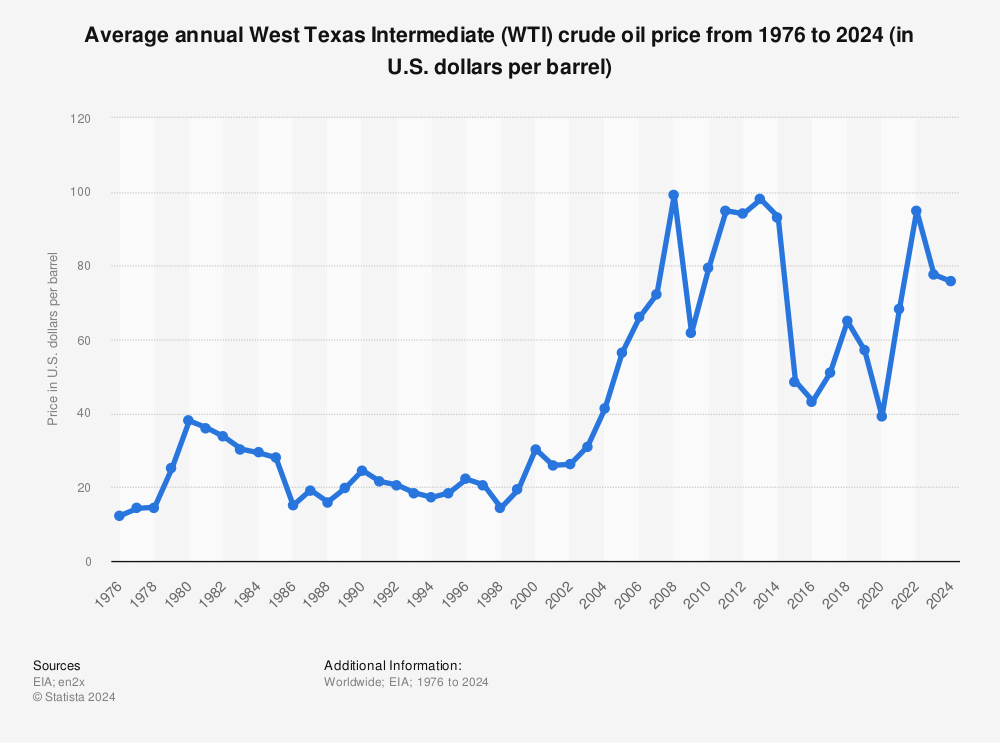
If you look at a long-term WTI crude oil price chart, one thing becomes clear very quickly: WTI crude oil prices are highly volatile, ranging from as low as USD 20 to USD 100 per barrel in the past 25 years.
Let’s zoom in on a few recent high-volatility periods to understand what’s going on.
1999 to 2008 [8]
The average price of crude oil had been trending predominantly downwards throughout the 1990’s, with the 1998 Asian Financial Crisis bringing new lows. Oil prices had just started to recover when the 9/11 terrorist attack in 2001 in New York caused a temporary drop.
WTI prices rose strongly through the 2000s, culminating in a major spike to USD 100 per barrel in 2008. A key driver was stronger global demand, particularly from fast-growing economies such as China and India, alongside broader global expansion. This period is one of the clearest examples of how rising demand can push the price of WTI crude oil sharply higher.
2008 to 2014 [9]
The swift rise of WTI crude oil prices to unprecedented levels was put to an abrupt stop when the 2008 Financial Crisis took place, caused by the collapse of the subprime mortgage market in the United States. By 2009, WTI averaged USD 60 per barrel, a far cry from its heyday just months prior.
Over the next couple of years, oil prices recovered in tandem with improving global economic conditions. There was some volatility caused by political developments in the Middle East; in particular, supply disruptions during the Arab Spring in 2011 caused a temporary spike in oil prices again.
The WTI oil price remained high from 2011 to 2014, driven by continued geopolitical tensions, supply disruptions, and growing demand from emerging economies. But things would once again change, due to an unexpected development.
2014 to 2018 [10]
In mid-2014, producers in the United States pioneered hydraulic fracturing, causing a boom in shale oil production. This created a supply glut as the United States became the world’s largest producer of oil.
In response, Saudi Arabia led OPEC (Organisation of Petroleum Producing Countries) to increase production so as to protect market share. The sharp increase in supply and decrease in demand caused average WTI crude oil prices to fall sharply, leading to one of the most severe downturns in oil prices throughout 2015 and 2016.
Eventually, the oil market stabilised, as production was reduced worldwide, allowing oil prices to mount a gradual recovery in 2018. This was attributed to improving global economic conditions, supply disruptions in Venezuela and other countries, and the re-imposition of sanctions on Iran by the United States.
2018 to 2022 [11]
After recovering in 2018, the WTI oil price once again reversed, due to continued oil production in the United States. The downturn continued throughout 2019 and worsened when the COVID-19 pandemic began.
As the world went into lockdown, oil demand slowed dramatically, causing oil prices to free-fall. In 2020, US oil futures fell into the negative, a development that shook up the industry.
Thankfully, the pandemic was soon brought under control. As the world started opening up again, oil prices began to rise, powered partly by supply shocks that saw prices spike in 2022.
WTI crude oil prediction [12]
According to the Dallas Fed Energy Survey for Q1 2024, oil executives have a positive outlook for the WTI oil price this year.
The WTI oil price per barrel is expected to range between a low of USD 70 and a high of USD 120, and the commodity is expected to end the year at USD 80.11 per barrel.
The latest round of predictions was slightly improved over December’s, which had the WTI oil price at a low of USD 51 and a high of USD 110, with an end-of-year prediction at USD 77.68 per barrel.
These predictions are based on the geopolitical situation remaining the status quo. JPMorgan warns that WTI crude oil prices could shoot up dramatically if Russia decides to cut oil production in retaliation for the sanctions levied against it for the invasion of Ukraine.
What affects WTI crude oil prices?
The price of WTI crude oil is influenced by a wide range of factors. Because crude oil is such an important global commodity, WTI crude oil prices tend to respond to changes in supply and demand, macroeconomic conditions, and geopolitical developments.
Let’s break that down.
Supply and demand levels
At the most basic level, the WTI oil price is driven by supply and demand.
Demand for crude oil tends to rise when the global economy is growing strongly and industrial activity is increasing. Major sources of demand include:
- manufacturing and industrial production
- logistics and freight transport
- aviation
- personal transportation
When demand is high, the price of WTI crude oil tends to rise. When demand weakens, prices often fall. A clear example was seen during the COVID-19 pandemic, when global lockdowns caused demand to collapse and pushed WTI crude oil prices into negative territory in 2020 [13].
Supply matters just as much. When oil production increases sharply, prices can come under pressure. For example, the rise of US shale production through hydraulic fracturing added a large amount of supply to the market, contributing to the oil price downturn seen in 2015 and 2016.
Macroeconomic factors and geopolitical issues [14,15]
Over the short term, the WTI oil price can also be affected by macroeconomic data and futures market activity. Since WTI is traded through futures contracts, which are binding agreements that give one the right to purchase oil by the barrel at a predefined price on a predefined future date. Buyers and sellers are obligated to fulfil their side of the transaction on the specified date.
If traders believe that supply could tighten, demand could weaken, or spare capacity is shrinking, those expectations can quickly be reflected in the market. This is why sentiment can have a strong effect on WTI crude oil prices.
Traders often rely on official data and market reports to form these views, including:
- OPEC’s monthly oil market reports
- the IEA oil market report
- weekly inventory data from the EIA
- inventory estimates from the API
These reports can all influence the WTI crude oil price chart, especially when the data differs from market expectations.
Geopolitical Issues
Geopolitical events can also have a major impact on the WTI oil price.
This is because oil supply is highly sensitive to political instability, conflict, and government decisions. Some of the most important examples include:
- Wars involving oil-producing countries or regions
Conflicts can disrupt production and transport, which may push prices higher. One recent example was the Russia-Ukraine war, which contributed to a sharp rise in crude oil prices to above USD 110 per barrel in 2022. - OPEC production decisions
OPEC is a group of 13 oil-producing countries that together control 40% of the world’s oil output. The organisation transparently attempts to exert control over oil prices by raising or cutting production. With the increase in US oil production, OPEC’s influence is no longer as severe, but its decisions continue to be closely monitored. - Government policies and energy transition measures
Policies aimed at reducing fossil fuel use may affect long-term oil demand. At the same time, reduced investment in supply could tighten the market and influence the price of WTI crude oil during periods of strong demand.
Types of WTI crude oil trading
Most WTI crude oil trading happens on the futures market. However, futures contracts are complex and carry high risks, making them better suited for advanced or highly experienced investors.
If you’re an everyday investor looking to capitalise on the WTI oil price without the steep learning curve, there are much simpler, more accessible instruments you can use:
Oil Exchange-Traded Funds (ETFs) [16]
Oil ETFs give you indirect exposure to WTI crude oil prices by tracking a “basket” of companies involved in the oil industry. This can include businesses focused on prospecting, extraction, production, and distribution of the WTI oil.
Two of the most well-known oil ETFs are the United States Oil Fund (USO) and the United States 12 Month Oil Fund (USL). Both of these are available to trade on the Vantage platform, allowing you to gain exposure to the WTI oil market through a regulated instrument.
How to choose: Because different ETFs focus on different parts of the energy sector, it’s important to research a fund’s specific goals and the underlying companies it holds. This ensures it actually aligns with your overall investment strategy.
Best for: A longer-term strategy. Oil markets can be highly volatile in the short term, so ETFs are generally better for investors willing to ride out the bumps.
Oil and energy stocks
While ETFs offer a broad mix of securities, buying individual oil stocks lets you invest directly in specific companies.
The upside: You get to concentrate your money on a few well-performing companies without owning stocks you don’t want. If your picks turn in winning performances, you have the potential to beat average market returns.
The downside: Putting your money into individual stocks is riskier than buying a diversified ETF. If a specific company struggles, your losses could be larger than the broader market average. It can also require more upfront capital to build a strong portfolio of individual stocks. For a less capital-intensive alternative, consider trading WTI contracts-for-difference (CFDs), discussed below.
Oil Contracts-for-Difference (CFDs)
The fast-paced changes in the price of WTI crude oil can be highly attractive to traders looking to make profits over a short period—though this naturally comes with the risk of significant losses, too.
How it works: A CFD is a financial derivative. Essentially, it is a contract that allows you to trade on the movement of WTI crude oil prices over a timeframe of your choosing. You exchange the difference in the WTI oil’s price from the moment you open the contract to the moment you close it.
If the price moves the way you predicted, you close the contract for a profit. If it moves against you, you take a loss. Unlike futures, WTI oil CFDs are settled entirely in cash. You never actually take ownership of the underlying commodity, eliminating the headache of physical storage.
On Vantage, you can access the WTI CFD market through two primary tickers:
How to trade WTI crude oil
Looking to trade WTI crude oil? Follow here’s a step-by-step guide to get you started.
Start WTI crude oil trading
1. Open a live account
Firstly, sign up for a Vantage trading account. You will need to open a Live account to trade WTI oil CFDs.
Follow the on-screen instructions to apply for your trading account. Once your account has been approved, you may fund your account to start trading.
2. Decide which WTI crude CFD you will trade.
Platforms typically offer different ways to trade. For example, Vantage offers two ways to trade WTI Crude Oil CFDs:
- WTI Crude Oil Cash CFD (USOUSD): This allows you to trade based on the current, on-the-spot WTI oil price.
- Crude Oil Future CFD (CL-OIL): This option lets you trade against the future expected price of crude oil. Keep in mind that oil futures are more complex and are generally better suited for advanced or highly experienced traders.
3. Research and analyse the WTI crude oil market
Unless you have a crystal ball, lasting success in the oil markets requires a firm grasp of current events. It is essential to research the market to understand exactly how WTI crude oil prices respond to geopolitical shifts, supply changes, and macroeconomic developments. This knowledge empowers you to make informed, calculated decisions. You may stay updated with the Market Analysis on Vantage.
4. Build WTI crude trading strategies
As your knowledge of the WTI crude oil market grows and you get a better grasp of your trading style and preferences, you should start building your own set of trading strategies.
This will help you identify opportunities and improve decision-making when trading the highly volatile WTI crude oil market.
Trade WTI Crude Oil Prices Using Fundamental Analysis
Fundamental analysis is a core discipline for any serious investor. It involves studying the real-world factors that drive a security’s value.
For a commodity like WTI crude, the main price drivers are global supply and demand, alongside macroeconomic and geopolitical factors. Practically, this means keeping a close eye on global news, economic reports, and expert analyst opinions.
A Real-World Example:
Consider how geopolitical events impacted the market in February 2024. Following news that Israel rejected a ceasefire offer from Hamas, crude oil futures jumped by about 3.2% [17]. The rejection dashed hopes for a quick resolution to the armed conflict, which threatened to disrupt global oil supplies.
While Israel’s own refining capacity is relatively small (about 300,000 barrels per day), the broader concern was contagion. A prolonged conflict could easily draw in other Middle Eastern nations, significantly reducing global export levels. According to the World Bank, this kind of severe supply squeeze has the potential to drive crude oil prices to new record highs [18].
Trade WTI Crude Oil Prices using Technical Analysis
Technical analysis relies on chart data and mathematical indicators to spot patterns and predict whether a price trend is likely to continue.
By filtering out market noise, technical analysis enables traders to focus solely on price action—widely regarded as the most reliable indicator of market sentiment. While studying historical WTI crude oil prices doesn’t guarantee future outcomes, it is an invaluable tool for making informed trading decisions and timing your entry and exit points.
Let’s look at how to analyse the price of WTI crude oil using two popular indicators: the 3EMA and the RSI.
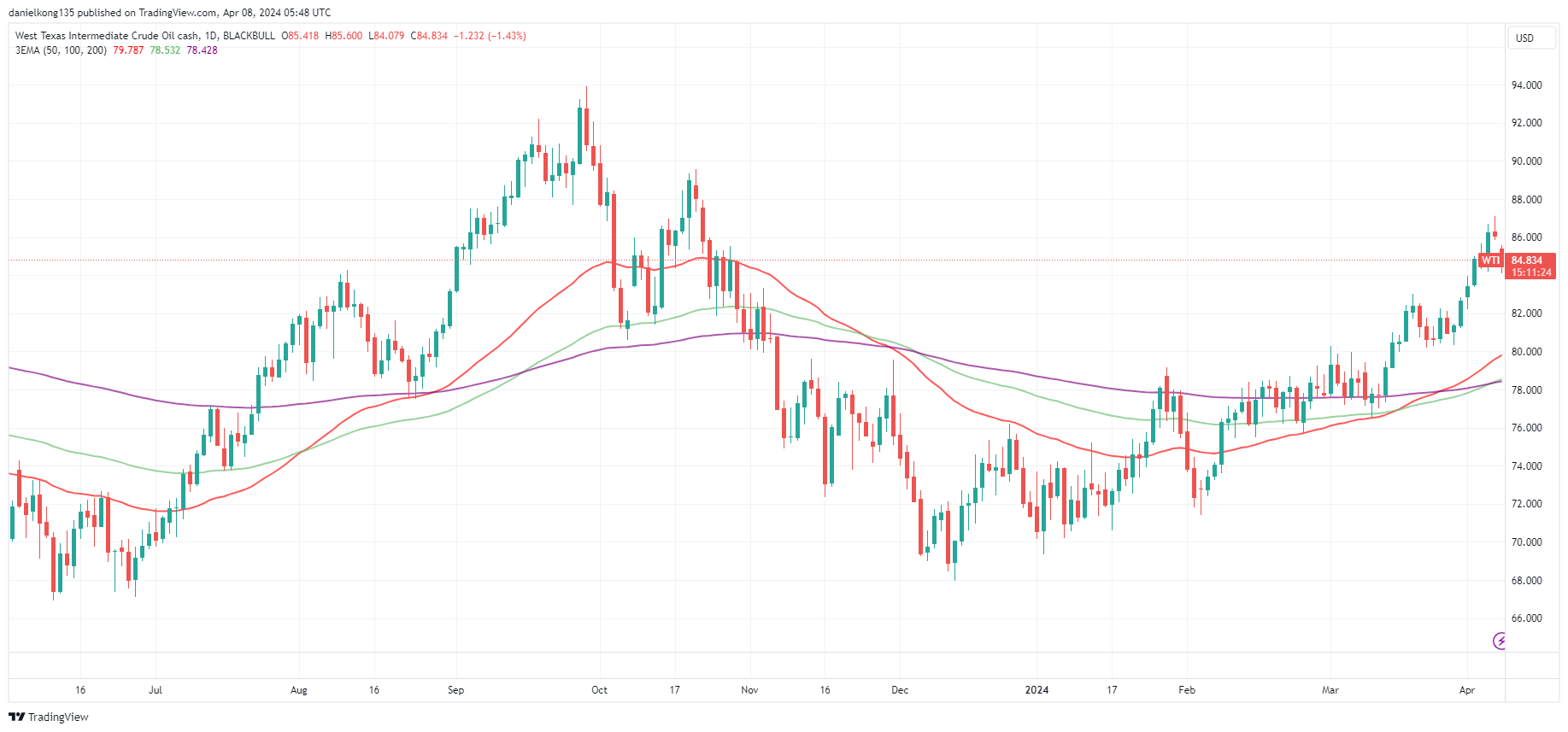
Using the 3EMA (Triple Exponential Moving Average)
A moving average is a lagging indicator that smooths price data over a specified period. Moving averages may be simple (all prices have equal weight) or exponential (the latest prices have more weight). The 3EMA uses three Exponential Moving Averages, giving greater weight to recent prices than a standard simple moving average.
The red and green candlesticks make up the price chart. In the chart example (July 2023 to April 2024), we see three EMA lines tracking the WTI oil price: 20-day (green), 50-day (yellow), and 200-day (red).
Here is how to read the crossover signals:
- Bullish Signal: When a shorter-duration EMA crosses above a longer-duration one (upward momentum)
- Bearish Signal: When a shorter-duration EMA crosses below a longer-duration one (downward momentum)
Between August and October 2023, the market was in a clear bullish trend. You can see this reflected by the 20-day EMA (green line) riding high above the other two lines.
Looking at the right side of the chart, another bullish trend is forming, highlighted by consecutive green candles. The green EMA line has stayed above the yellow one and recently broke upward through the red one. This suggests the market is entering a strong bull run, and this rally could last as long as the green line continues to diverge upward from the others.
RSI for WTI crude oil trading
The Relative Strength Index (RSI) is a momentum indicator used to determine if an asset is currently overbought or oversold. The index ranges from 0 to 100, with 30 and 70 as the standard thresholds.
- Under 30 (Oversold): Indicates the asset is under-traded. The WTI oil price may be undervalued and due for a bounce.
- Over 70 (Overbought): Indicates the asset is over-traded. The price may be inflated and due for a pullback or correction.
This means that when the RSI is under 30, this indicates under-trading, and thus, the price at the time is likely to be reasonable. If the RSI is over 70, this indicates the asset is over-traded, and the price is likely to be too high as a result.
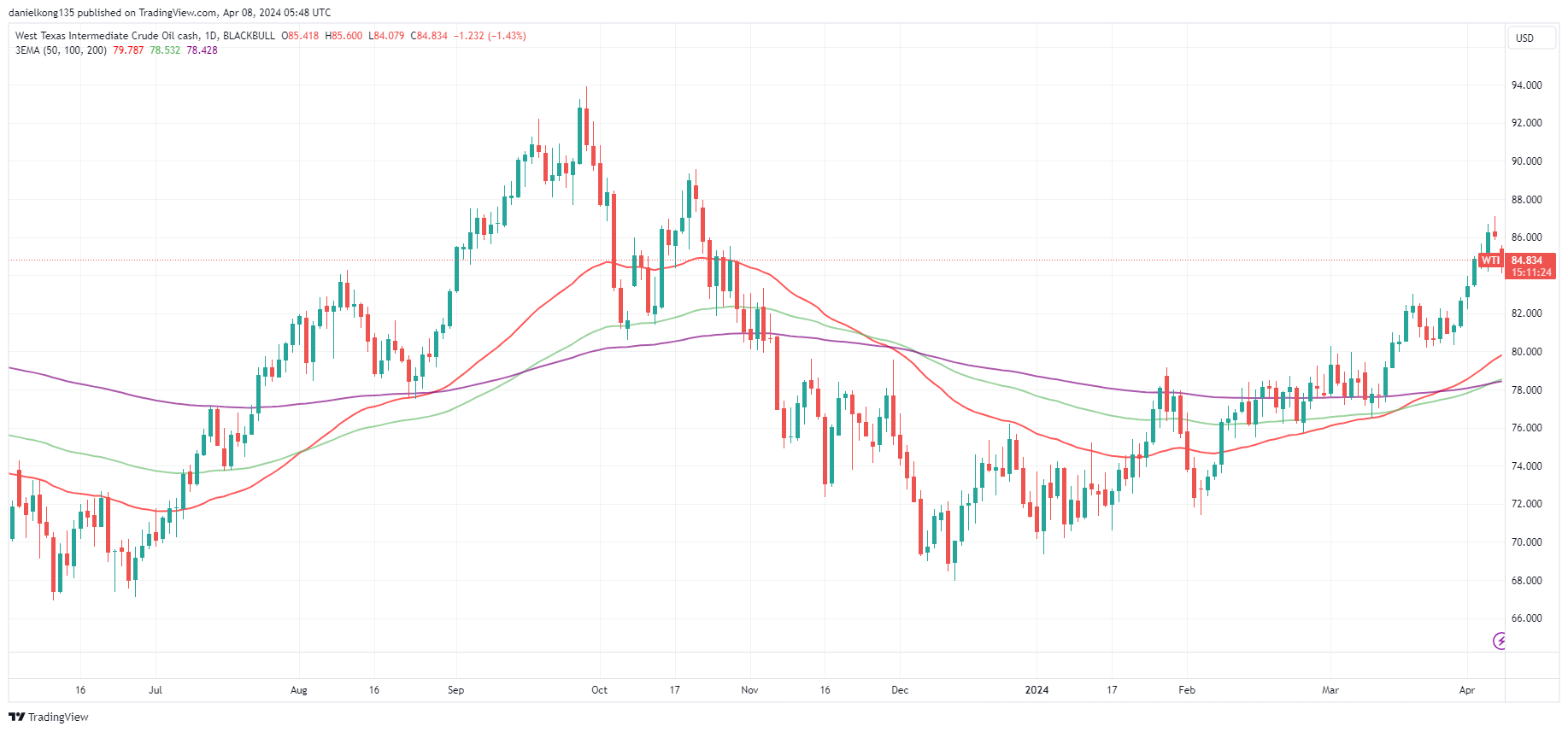
In the second chart, the RSI is located on the bottom half of the screen. The purple line is the RSI itself (we can ignore the yellow moving average line for now), oscillating within the shaded purple area that represents the 30-to-70 band.
Earlier, the 3EMA signalled that spot prices were entering a bullish trend. Looking at the RSI on the right side of the screenshot, the upward slope of the purple line confirms this bullish market sentiment.
The good news for buyers is that the RSI has not yet crossed the 70 mark into “overbought” territory. This means there is still headroom for the price to grow, supporting the expectation that the bull rally has room to run. Conversely, if the RSI were already sitting above 70 at the start of a rally, traders might assume the price is already too high, making the trend short-lived as people rush to sell and take quick profits.
Here’s the screenshot of WTI crude oil prices again. The RSI is in the bottom half of the screen. The Index proper is the purple line, and the yellow line is the RSI moving average, which we will ignore for now. The purple shaded area represents the bounds between 30 (oversold) and 70 (overbought).
Earlier on, the 3EMA indicates that WTI spot prices are entering a bullish trend. When you look at the RSI on the right side of the screenshot, the upward slope of the purple line confirms the bullish sentiments of traders. The good news is the RSI has yet to enter overbought territory – meaning there is headroom for the price to grow, lending further support to the expectation that the bull rally will last for a period of time.
If, however, the RSI is already at overbought levels at the beginning of the rally, the bullish trend may be short-lived as traders may feel the price is too high and strive to make a quick exit.
Risk management when trading WTI crude oil
Crude oil is a notoriously volatile commodity. History is full of wild price swings, and WTI is no exception. Because the market is hyper-sensitive to geopolitical events and macroeconomic shifts, predicting the price of WTI crude oil can be a complex and unpredictable challenge.
To protect your capital, it is crucial to implement these core risk management measures:
Proper trade sizing
It can be tempting to place a large bet in hopes of a massive payoff, but this lack of discipline often leads to heavy losses. Instead, you should stick to a consistent trade size regardless of how confident you feel about a specific move in WTI crude oil prices.
- The Golden Rule: Generally, you should risk no more than 1% to 2% of your total capital on any single trade. As your account grows, you may even consider reducing this percentage further to protect your gains [19].
Caution when using leverage
Many traders use CFDs to gain exposure to the WTI oil price because they allow for leverage. While leverage lets you trade with less upfront capital, it acts as a double-edged sword by amplifying both profits and losses.
- The Risk: In extreme cases, leverage can cause losses that exceed your initial deposit, leading to a negative account balance.
- The Strategy: Use leverage sparingly. It is best reserved for when you have built up enough experience and emotional discipline to handle the increased stakes.
Setting stop-losses and take-profit levels
To remove emotion from the equation, traders use predetermined price points to automatically close their positions.
- Stop-Loss: It closes a losing trade at a specific price to prevent a bad situation from becoming a catastrophic one.
- Take-Profit: This ensures you don’t get greedy. It closes a winning trade once a target price is hit, locking in your gains before the market has a chance to reverse.
WTI crude oil trading strategies
Building a personal set of strategies is essential for instilling discipline and focus. Having a “game plan” prevents emotional decision-making when the WTI oil price starts to move rapidly.
Here are the most common strategies used to navigate the market:
Day trading
Day trading involves making multiple short-term trades that last anywhere from a few minutes to several hours.
Day traders rarely hold positions overnight. They aim to capture small returns from WTI crude oil prices throughout a single session.
Because the movements are small, day traders often use leverage to amplify their results, though this significantly increases the risk of loss.
Position trading
In contrast to day trading, a position trading strategy involves holding a position in the WTI crude market over a comparatively longer time frame. The goal is to make a profit when the market moves in a favourable direction.
Position traders may use both long and short positions to hedge against risk and to expand the range of trading opportunities in the crude oil market. This strategy is well-suited to a variety of WTI crude oil instruments, including oil stocks and ETFs.
Swing trading
Swing trading attempts to reap returns when the price swings from up to down or down to up over several days or weeks. This involves speculating on expected WTI crude price movements based on market sentiment, macroeconomic news or geopolitical events. Some swing traders also rely on technical analysis to identify an upcoming swing.
This trading strategy is slower paced than day trading, as traders have the option to keep their trades open for significantly longer durations – typically all the way until the swing runs its course.
Read our guide on “Position Trading vs Swing Trading” to help you understand each strategy better.
Trend following
The core idea here is simple: trade with the trend, not against it.
If the overall WTI oil price is climbing, you take a long position; if it’s falling, you go short. Success depends on accurately identifying the trend’s momentum using technical indicators and having the discipline to exit once the trend ends.
Trend traders are apt to use technical indicators on a price chart to gauge trend momentum and direction.
Sentiment trading
As per its name, sentiment trading is a trading strategy based upon market sentiment towards WTI crude oil prices.
When the outlook is optimistic, and prices are expected to rise, sentiment traders open long positions. When the mood turns sour, they might switch to short-selling.
Because the WTI crude oil market is so volatile, it takes a lot of experience to filter out temporary “noise” and focus on the sentiment that actually drives the market.
News trading
News trading is similar to sentiment trading in that trades are made as news events are announced. In particular, earnings reports by WTI crude oil companies, political announcements such as elections, and economic reports like inflation readings and employment levels are especially potent in a news trading strategy.
To be successful, a news trader must be able to evaluate relevant news reports and form the correct theories to support the trades they make.
WTI crude oil trading hours
The trading hours for WTI crude depend on where you choose to carry out your trading. If you’re trading WTI futures, you’ll need to adhere to the trading hours of the exchange on which they are offered, such as the NYMEX.
Meanwhile, if you choose to trade WTI crude using other instruments such as CFDs, stocks and ETFs, you will be able to make trades according to the online brokerage you choose.
WTI crude futures trading hours on Intercontinental Exchange Inc (ICE) [20]
| City | Trading hours | Pre-open |
| New York | 8pm to 6pm (next day) | 7.45pm |
| London | 1am to 11pm (next day) | 12.45am |
| Singapore | 9am to 7am (next day) | 8.45am |
Market open time for Monday morning/Sunday evening is 23:00 London (local time)
WTI crude CFDs
Vantage offers trading in WTI CFDs during the following time periods:
| Description | Symbol | Trading time (GMT+2) |
| WTI Crude Oil Cash | USOUSD | Monday – Friday:01:00-24:00 |
Key takeaways for WTI crude oil trading
WTI (West Texas Intermediate) is the primary benchmark for the US oil market. Thanks to the rise of advanced extraction methods like hydraulic fracturing, WTI has solidified its place as a top alternative to Brent for those looking to trade energy markets.
To wrap up, here are the essential points to remember:
- Market Drivers: While WTI and Brent are geographically distinct, they often follow similar paths. Both are heavily influenced by global economic shifts and OPEC decisions. However, unique regional supply and demand factors can cause the WTI oil price to decouple and move independently from Brent.
- Volatility is the Norm: WTI is known for its high volatility. In just twenty years, we have seen WTI crude oil prices swing from $20 to over $100 per barrel. This sensitivity to geopolitical news and economic reports creates frequent opportunities—and risks—for traders.
- Accessible Trading Options: While the professional market relies on futures contracts, these require physical delivery and are often too complex for retail investors. To trade the price of WTI crude oil without the headache of physical storage, more manageable options include:
- Energy ETFs such as USO and USL, for broad exposure.
- Oil Stocks for targeted company investment.
- CFDs for flexible, cash-settled trading on price movements.
Trade WTI crude CFDs with tight spreads at Vantage
Experience the advantage of trading with a platform designed for speed and transparency. Vantage offers tight spreads starting from 0.0, allowing you to trade WTI crude oil prices via CFDs with minimal overhead.
- Low Cost: Benefit from a fee structure with no deposit fees, no monthly rollover fees, and no hidden costs.
- Powerful Platforms: Choose between MT4, MT5, or the Vantage mobile app to trade on the go. Our platforms are equipped with the tools you need to react instantly to market shifts.
- Flexible Strategies: Whether you want to go long in a bull market or short in a bear market, our tools help you execute your strategy and manage your risk effectively.
Ready to start? Trade WTI crude via CFDs with Vantage today and experience the difference. Sign up now to claim your deposit bonus* and power up your first trade!
*Terms & Conditions apply.
Frequently Asked Questions (FAQs)
Q1. What is the spread on WTI crude oil assets at Vantage?
We offer tight spreads for WTI CFDs, starting from as low as 0.0. Trade at minimum cost with Vantage.
Q2. What are the risks of WTI crude oil trading?
When trading WTI crude oil, one of the main risks is volatility. Being an essential commodity that underpins the world economy, the price of WTI is highly sensitive to various economic and political events.
Traders should be aware that wild price swings can happen when trading WTI, and should take appropriate risk management measures. They should also expect to invest substantial time and effort in studying the market, and keeping track of news, trends and developments that could impact the price of WTI crude oil.
Q3. What are the additional tips for trading WTI crude oil?
The complexity involved in crude oil extraction, production, distribution and storage can mean that producers are sometimes slow to react to changes in demand, contributing to high price volatility.
As such, traders need to be able to react swiftly to take advantage of potential opportunities. To this end, investors should consider choosing an online brokerage that offers fast, reliable connectivity and feature-rich trading platforms with an array of flexible and powerful tools.
Q4. Does Brent crude price affect WTI price?
With the United States now being a major global producer of crude oil, the prices of WTI and Brent have been observed to share a correlation. Both indices often move in the same overall direction, as Brent and WTI are often affected by the same developments – such as a global economic recession.
However, differences in supply can cause the price trends of both to diverge. For instance, WTI is based on oil production taking place in landlocked regions of the United States; this is considered a more stable source of supply, and thus more resilient to troubling geopolitical events affecting other parts of the world. Brent, being a global benchmark, is more sensitive to a larger array of events.
Read our guide on the difference between Brent Crude and WTI Crude to help you understand how fluctuations in these prices can impact the global oil market.
Q5. Can I practise WTI crude oil trading?
Yes. Traders and investors wishing to practise WTI crude trading and test out trading strategies on paper may do so by signing up for a free Vantage demo account. There are no fees or minimum deposit required to practise WTI oil trading with a demo account.
References
- “West Texas Intermediate (WTI): Definition and Use as a Benchmark – Investopedia”. https://www.investopedia.com/terms/w/wti.asp . Accessed 5 April 2024.
- “Energy Investing Basics: WTI vs. Brent Crude Oil – Charles Schwab”. https://www.schwab.com/learn/story/energy-investing-basics-wti-vs-brent-crude-oil . Accessed 8 April 2024.
- “PERMIAN BASIN DATA STATS NEWS & INFO – Enverus”. https://www.enverus.com/permian-basin/ . Accessed 5 April 2024.
- “History of O&G in the Permian Basin – Integrity Wireline”. https://www.integritywireline.com/history-of-og-in-the-permian-basin/ . Accessed 5 April 2024.
- “How to Invest in Oil – Investopedia”. https://www.investopedia.com/ask/answers/08/oil-as-investment.asp . Accessed 5 April 2024.
- “An oil futures contract expiring Tuesday went negative in bizarre move showing a demand collapse – CNBC”. https://www.cnbc.com/2020/04/20/oil-markets-us-crude-futures-in-focus-as-coronavirus-dents-demand.html . Accessed 5 April 2024.
- “How Oil Prices Affect the Stock Market – Investopedia”. https://www.investopedia.com/ask/answers/030415/how-does-price-oil-affect-stock-market.asp . Accessed 5 April 2024.
- “Long-term investment trends: the crude oil boom in the 2000s – LGT Private Banking”. https://www.lgt.com/sg-en/market-assessments/insights/financial-markets/long-term-investment-trends-the-crude-oil-boom-in-the-2000s-91686 . Accessed 5 April 2024.
- “History of Oil Prices – Investopedia”. https://www.investopedia.com/history-of-oil-prices-4842834 . Accessed 5 April 2024.
- “What triggered the oil price plunge of 2014-2016 and why it failed to deliver an economic impetus in eight charts – World Bank Blogs”. https://blogs.worldbank.org/en/developmenttalk/what-triggered-oil-price-plunge-2014-2016-and-why-it-failed-deliver-economic-impetus-eight-charts . Accessed 5 April 2024.
- “What Happened to Oil Prices in 2020 – Investopedia”. https://www.investopedia.com/articles/investing/100615/will-oil-prices-go-2017.asp . Accessed 5 April 2024.
- “Oil and Gas Executives Predict WTI Oil Price – Rigzone”. https://www.rigzone.com/news/oil_and_gas_executives_predict_wti_oil_price-29-mar-2024-176242-article/ . Accessed 5 April 2024.
- “Making History: Coronavirus and Negative Oil Prices – Global Risk Insights”. https://globalriskinsights.com/2020/05/making-history-coronavirus-and-negative-oil-prices/ . Accessed 8 April 2024.
- “Top Factors That Affect the Price of Oil – Investopedia”. https://www.investopedia.com/articles/investing/072515/top-factors-reports-affect-price-oil.asp . Accessed 5 April 2024.
- “How does the war in Ukraine affect oil prices? – World Economic Forum”. https://www.weforum.org/agenda/2022/03/how-does-the-war-in-ukraine-affect-oil-prices/ . Accessed 5 April 2024.
- “Oil ETF: What It is, How it Works, and Challenges – Investopedia”. https://www.investopedia.com/terms/o/oil-etf.asp . Accessed 5 April 2024.
- “Oil up 3% on Gaza ceasefire rejection and US fuel stocks data – Reuters”. https://www.reuters.com/markets/commodities/oil-edges-up-with-slim-progress-gaza-peace-talks-2024-02-08/ . Accessed 5 April 2024.
- “Oil price could reach $150 a barrel in 2024, warns World Bank – Offshore Technology”. https://www.offshore-technology.com/news/world-bank-say-oil-price-could-reach-150-next-year/ . Accessed 5 April 2024.
- “Risk Management Techniques for Active Traders – Investopedia”. https://www.investopedia.com/articles/trading/09/risk-management.asp . Accessed 5 April 2024.
- “WTI Crude Futures – ICE”. https://www.ice.com/products/213/WTI-Crude-Futures . Accessed 5 April 2024.