



Gold does not attract this much attention without reason.
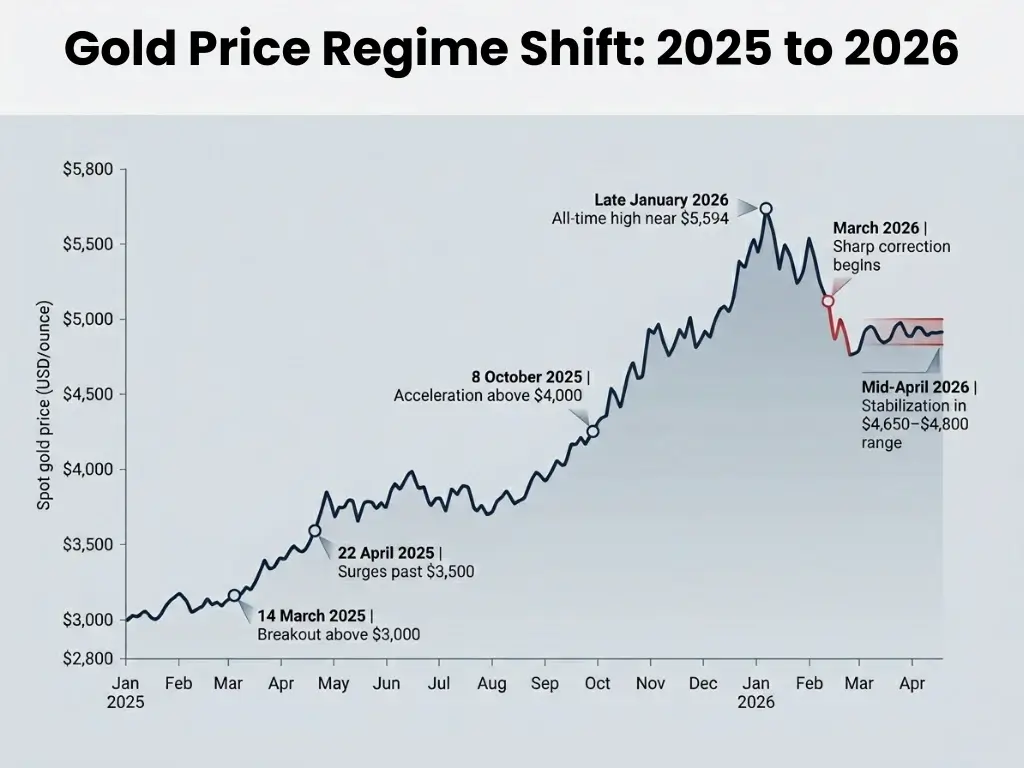
Through 2025, it delivered its strongest calendar-year gain since 1979. It then climbed to a record high in late January 2026, with market data showing January highs above $5,600 an ounce, before falling sharply in March as a stronger US dollar unsettled the market [1,2].
Gold’s safe haven reputation was built over decades, not headlines. It has historically held value during periods of stress, carries no counterparty risk, and remains liquid when other markets come under pressure.
But traders are now dealing with a more difficult question. If the old relationships are weakening, what still makes gold a safe haven — and how should it be read now?
Key Points
- Gold has earned its safe haven status through scarcity, liquidity, and the absence of counterparty risk, and it has often preserved value during market stress.
- That status is not automatic. Gold can weaken during forced sell-offs, and it has historically faced headwinds from rising real yields and a stronger US dollar.
- The 2025 to 2026 cycle has shown that gold is now being driven by more than the old playbook, with central bank demand, ETF inflows, and shifting market relationships playing a larger role.
What Does “Safe Haven” Actually Mean?
The term ‘safe haven’ is often used loosely, but it has a specific meaning in markets.
A safe haven asset is expected to hold its value, or rise, during periods of economic stress, financial instability, or geopolitical tension. What matters most is how it behaves when broader risk assets come under pressure.
That is different from simply being low risk. A government bond from a stable economy, for example, may be seen as defensive because of its income and credit quality. But a true safe haven is valued for something else: its ability to remain resilient when markets fall.
Why Gold Has Long Been a Safe Haven Asset
Gold’s safe haven status did not emerge by chance. It rests on a set of characteristics that few other assets share, and together they help explain why gold has remained valuable during periods of uncertainty.
Scarcity and a Fixed Stock
Gold is finite and difficult to produce. The total above-ground stock grows slowly through mining, typically by around 1.5% to 2% a year [3]. That is modest compared with the pace at which fiat currencies can be expanded, which helps protect gold from supply-driven debasement.
No Counterparty Risk
Physical gold is not tied to any issuer or institution. Shares depend on a company staying solvent. Bonds depend on an issuer meeting its obligations. Fiat currencies depend on trust in governments and central banks.
Gold does not carry those risks. That matters more when banks come under pressure, sovereign debt concerns rise, or confidence in financial institutions starts to weaken.
To understand how gold sits within the broader commodity and currency landscape, read our article on ‘Is Gold A Commodity?’.
Universal Recognition and Liquidity
Gold is recognised, priced, and traded across nearly every major financial market. According to the World Gold Council, average daily trading volume is around $361 billion in 2025, which places gold ahead of many major currency pairs and close to parts of the Treasury market [4].
That depth matters. In periods of stress, traders can usually enter or exit gold positions in size without the sharp price gaps often seen in thinner markets.
Gold’s Performance in Past Market Crises
Gold has generally preserved value during major financial disruptions, though not in every case and not always immediately. The table below summarises how gold performed during several well-known episodes of market stress.
| Market Crisis | Gold Return | S&P 500 Return | Notes |
| 2000–2002 dot-com bust | +1.41% (2001), +23.96% (2002) | -11.89% (2001), -22.10% (2002) | Gold held up better while equities suffered back-to-back declines. |
| 2008 global financial crisis | +3.97% | -37.00% | Gold finished slightly positive despite forced selling during the panic. |
| 2020 COVID-19 shock | +25.75% | +18.40% | Both assets rose on stimulus support, with gold outperforming overall. |
| March 2023 banking stress | +2.08% | -18.11% | Gold acted as a relative cushion during renewed pressure on equities. |
| 2024–2025 geopolitical escalation and trade war | +27.20% | +25.02% | Gold stayed ahead as geopolitical risk and central bank demand remained supportive. |
Two points stand out. Gold does not always rise at the height of a crisis.
In 2008 and 2020, it fell briefly alongside equities as investors rushed to raise cash. But in both episodes, it later recovered while stocks remained under pressure. That distinction matters: a safe haven is not the same as an asset that never falls.
To understand how gold prices move, read our article covering Gold Price Over Time.
When Gold Becomes Less Reliable as a Safe Haven
A balanced view of gold also means recognising where its safe haven role can weaken. Three conditions tend to stand out:
1. Forced Liquidation Events
Gold does not always rise during the most acute phase of a crisis. In late 2008 and again in March 2020, it fell alongside other assets as investors rushed to raise cash. In those moments, gold’s liquidity can work against it because it is one of the easier assets to sell.
The longer-term safe haven behaviour may return once the forced selling passes, but the short-term drawdown can still be meaningful.
2. Rising Real Yields (Historically)
Gold does not generate income. When real yields rise, the opportunity cost of holding it also increases. Historically, gold has shown a strong inverse relationship with real yields, particularly the 10-year Treasury, making higher rates a clear headwind for the metal.
3. Strong US Dollar
Gold is priced in US dollars, so a stronger dollar has usually weighed on prices. When the US Dollar Index (DXY) rises sharply, gold often comes under pressure, especially for investors outside the US whose own currencies are also weakening against the dollar.
The 2025 to 2026 Regime Shift
The gold market has not behaved in the usual way over the past eighteen months. That matters because some of the signals traders once relied on have become less dependable.
Through 2025, gold returned roughly 55% to 65%, its strongest calendar-year gain since 1979. The rally came in bursts. Gold broke $3,000 on 14 March 2025 as tariff tensions intensified, then moved above $3,500 on 22 April and $4,000 on 8 October during the US government shutdown. By late January 2026, spot gold had reached a fresh all-time high near $5,594.82 [6,7,8,9].
Then the market turned. In March 2026, gold corrected sharply and slipped back into the $4,650 to $4,800 range by mid-April. Even so, the pullback did not change the bigger point. Gold had already risen despite headwinds that would once have weighed more heavily on the metal.
The move also coincided with a weaker US dollar, suggesting this was more than a routine correction. Strong demand from central banks and private investors helped support gold even as older market relationships became less reliable.
Central Banks Have Become the Dominant Force
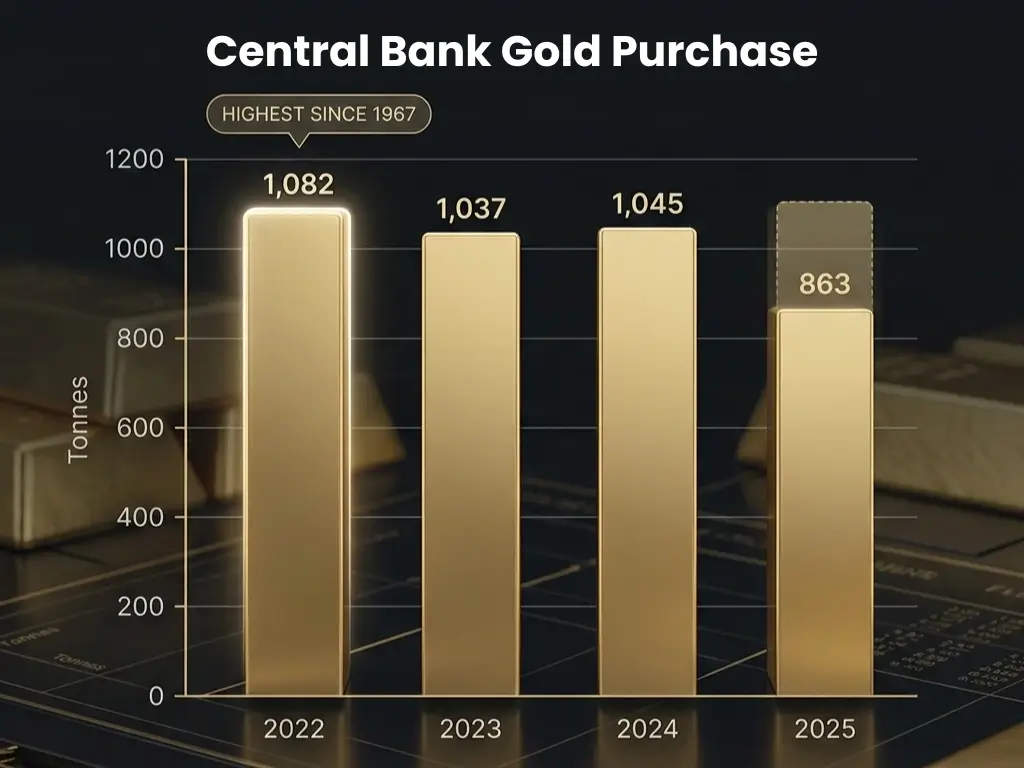
A large part of that support appears to have come from central banks. Official buying has remained unusually strong for several years, giving gold a firmer base than older market signals alone would suggest.
Net purchases reached 1,082 tonnes in 2022, the highest level since 1967 [10]. They remained elevated at 1,037 tonnes in 2023, 1,045 tonnes in 2024, and 863 tonnes in 2025 [11,12]. Metals Focus estimates that around 57% of 2025 buying went unreported, suggesting the true total may have been even higher.
Private Investment Has Returned in Force
Central banks were not the only source of support. Private investors returned in force as well.
Gold-backed ETFs took in a record $89 billion in 2025, adding 801 tonnes and lifting total holdings to an all-time high of 4,025 tonnes. Assets under management doubled to around $559 billion. The buying carried into 2026, with January recording the largest monthly inflow on record at $18.7 billion, led by Asian investors [13].
This added further depth to the rally. Gold was being supported by both official demand and renewed private investment.
Is Gold Still a Safe Haven Asset in 2026?
Gold still broadly holds safe haven status in 2026, but the answer is more conditional than absolute. Recent price action shows that gold can still attract demand during periods of stress, even if it no longer follows older market patterns as neatly as before.
For traders, three points stand out:
- Old signals need to be read with more care: Gold is no longer reacting only to real yields and the US dollar. Official demand, ETF flows, geopolitical risk, and futures positioning now matter more.
- Volatility remains part of the picture: The 10% drawdown in March 2026 showed that gold can still correct sharply, even within a broader uptrend.
- Long-term allocation and short-term trading should be treated differently: A strategic holding in gold serves a different purpose from a tactical XAU/USD trade, and confusing the two can lead to weaker decision-making.
Taken together, the evidence suggests that gold still matters as a safe haven, but it now needs to be judged through a broader and more nuanced market lens.
If you’re considering acting on this, read our article covering the 5 Benefits of Trading in Gold.
Frequently Asked Questions
Why do central banks buy gold?
Central banks hold gold as part of their official reserves for several reasons: it carries no credit risk, is not subject to any single government’s monetary policy, acts as a diversifier away from dollar-denominated assets, and has historically preserved value during crises.
Following the sanctions imposed on Russia’s reserves in 2022, many central banks accelerated their gold accumulation as part of a broader reserve diversification strategy.
Is Gold Still a Safe Haven in 2026?
Gold remains widely regarded as a safe haven asset, though its behaviour has evolved. Central bank buying and strong private investment demand have supported its role, but academic research and recent price action confirm that its safe haven properties are conditional rather than automatic.
Why Did Gold Fall in March 2020 and October 2008 if It Is a Safe Haven?
In both periods, investors faced margin calls and forced liquidation, which pushed them to sell even assets they wanted to hold. Gold’s liquidity became a short-term disadvantage. In each case, gold recovered once forced selling subsided and ended the crisis higher, while equities remained well below their peaks.
How Much Gold Should Be Held in a Portfolio?
The World Gold Council’s research suggests that strategic allocations between 2% and 10% have historically improved risk-adjusted returns in diversified portfolios.
The optimal figure depends on an individual investor’s overall risk profile, time horizon, and existing holdings. This is general information and not a personal recommendation.
Does gold perform better during geopolitical crises?
Historically, yes. Geopolitical uncertainty tends to reduce risk appetite and drive demand for safe haven assets. Academic research and recent market data both show a consistent positive relationship between rising geopolitical risk indicators and gold prices.
However, the magnitude of gold’s response depends on the specific nature and duration of the crisis, and past patterns do not guarantee future behaviour.
How Does Gold Perform During Inflation?
Gold has historically performed strongly during periods of high inflation combined with weak growth, such as the 1970s. Its performance during more moderate inflation is mixed and depends heavily on how central banks respond.
When real yields rise sharply to combat inflation, gold can underperform in the short term even if longer-term inflation expectations support it.
What Is the Difference Between Gold and Silver as Safe Havens?
Silver tends to move in the same direction as gold but with higher volatility, and its price is also influenced by industrial demand. The World Gold Council has found that silver’s beta to gold has averaged around 1.3 over two decades, meaning it typically amplifies gold’s moves rather than providing independent safe haven behaviour.
Can gold lose value in a bear market?
Yes, gold can and does decline in price. While it often moves inversely to equities during stress periods, it is not immune to broader market forces. Factors such as a strengthening US dollar, rising real interest rates, or reduced investor demand can push gold prices lower. Trading gold — in any form — involves risk of loss.
RISK WARNING: CFDs are complex financial instruments and carry a high risk of losing money rapidly due to leverage. You should ensure you fully understand the risks involved and carefully consider whether you can afford to take the high risk of losing your money before trading.
Disclaimer: The information is provided for educational purposes only and doesn’t take into account your personal objectives, financial circumstances, or needs. It does not constitute investment advice. We encourage you to seek independent advice if necessary. The information has not been prepared in accordance with legal requirements designed to promote the independence of investment research. No representation or warranty is given as to the accuracy or completeness of any information contained within. This material may contain historical or past performance figures and should not be relied on. Furthermore estimates, forward-looking statements, and forecasts cannot be guaranteed. The information on this site and the products and services offered are not intended for distribution to any person in any country or jurisdiction where such distribution or use would be contrary to local law or regulation.
Reference
- “Gold – Trading Economics” https://tradingeconomics.com/commodity/gold Accessed 17 April 2026
- “Gold extends decline on expectations of higher interest rates – Reuters” https://www.reuters.com/world/india/gold-loses-over-1-dollar-firms-fed-cut-hopes-fade-2026-03-24/ Accessed 17 April 2026
- “How Much Gold Is Left in the World? – J.Rotbart & CO” https://jrotbart.com/how-much-gold-is-left-in-the-world/ Accessed 17 April 2026
- “Gold as a strategic asset: 2026 edition – World Gold Council” https://www.gold.org/goldhub/research/relevance-of-gold-as-a-strategic-asset/key-attributes-liquidity Accessed 17 April 2026
- “Comparing gold vs the S&P 500 – Monetary Metals” https://www.monetary-metals.com/insights/articles/gold-vs-the-sp-500/ Accessed 17 April 2026
- “Gold pops above $3,000/oz for first time in historic safe-haven rally – Reuters” https://www.reuters.com/markets/commodities/gold-mounts-record-summit-eyes-3000-peak-2025-03-14 Accessed 17 April 2026
- “Gold takes a breather after hitting $3,500 on higher stocks, stronger dollar – Reuters” https://www.reuters.com/markets/commodities/gold-maintains-record-rally-following-trumps-criticism-fed-chief-2025-04-22/ Accessed 17 April 2026
- “Gold shatters $4,000 milestone, silver belts record high as investors rush to safety – Reuters” https://www.reuters.com/world/india/gold-vaults-over-4000-rush-safety-fed-easing-bets-2025-10-08/ Accessed 17 April 2026
- “Gold falls as investors take profits after record high – Reuters” https://www.reuters.com/world/india/gold-extends-record-run-races-past-5400oz-2026-01-28 Accessed 17 April 2026
- “2024 Central Bank Gold Reserves Survey – World Gold Council” https://www.gold.org/goldhub/research/2024-central-bank-gold-reserves-survey Accessed 17 April 2026
- “Gold Demand Trends: Full Year 2024 – World Gold Council”https://www.gold.org/goldhub/research/gold-demand-trends/gold-demand-trends-full-year-2024/central-banks Accessed 17 April 2026
- “Gold Demand Trends: Q4 and Full Year 2025 – World Gold Council” https://www.gold.org/goldhub/research/gold-demand-trends/gold-demand-trends-full-year-2025/central-banks Accessed 17 April 2026
- “ETF Flows – World Gold Council” https://www.gold.org/goldhub/research/etf-flows Accessed 17 April 2026