

Stocks Consolidate Awaiting Positive Hormuz News

Jamie Dutta >
Jamie Dutta >
Jamie Dutta is a Market Analyst for Vantage. He comes with extensive experience as a full-time trader and financial market commentator, having worked as a trader in top tier investment banks and trading houses.
 Updated Thu, 2026 May 28 02:00

- Trump says US ‘not satisfied’ with Iran deal yet
- Iran TV says Hormuz flows may return to normal within month of deal
- US stocks mixed as White House hesitates over peace agreement
- Marvell Tech jumps 4.5% on better than expected guidance
Forex
USD was relatively quiet again as FX volatility remains quite muted, even with risk events blowing hot and cold. Negotiations are supposed to be proceeding ‘nicely’ between the US and Iran for a peace deal, though some headlines still conflict with this rosy picture. The Dollar Index sits above the 50-day SMA at 98.91. Focus is next on the inflation data out later today, with expectations that solid data will lead to the need for the Fed to remove its implicit easing bias.
EUR tapped the 50-day SMA at 1.1661 but fell back. The world’s most traded currency pair remains sluggish despite the world seemingly days away from the US and Iran signing a Memorandum of Understanding to extend the ceasefire and reopen the Strait of Hormuz. Interestingly, the single currency failed to get much of a lift yesterday from ECB speakers Lane and Schnabel, firming up views for a 25bps rate hike at the ECB meeting on 11 June. But we did see dovish comments from other officials.
GBP dipped below the 50-day SMA at 1.3429 but stayed above the 200-day SMA at 1.3420. The pound is in no man’s land at the moment and is frustrating bears while not especially encouraging bulls.
JPY weakened as it again pushed away from the 2025 top and 50-day SMA around 158.87/74, and closer to 160 and the intervention zone which took place in late April. The major fell from 160.72 down to a low of the day at 155.53. Carry-seekers dominate yen trading and it may take an end to the Middle East conflict plus a few BoJ rate hikes to see some buyers and the major to fall.
AUD went south while NZD outperformed strongly on the day of the RBNZ meeting. The latter was a hawkish hold, as we expected, and there was a significant raise to the implied OCR track. Rates are predicted to hit 3.0% in early 2027 with a terminal rate of 3.25%, instead of gradual rises to 3% by end 2028. Notably, three members voted for an immediate rate hike, with the Governor having the deciding vote to hold fire. Australia CPI came in cooler than expected.
Stocks
US stocks: The S&P 500 added 0.02% to close at 7,520, the Nasdaq closed down 0.09% at 29,974 and the Dow Jones settled higher by 0.36% at 50,649. Sectors were mixed with Consumer Discretionary the leading sector while Energy and Financials led the laggards. The former was boosted by strength in Meta after it launched Instagram, Facebook, and WhatsApp subscriptions. Investment banks were out with market updates, as Goldman Sachs lifted its S&P 500 year-end target to 8,000, while Barclays strategists said investors still have capacity to chase the rally.
The memory bubble paused but kept raging in Asia as the market value of Korea’s SK Hynix sailed above the trillion-dollar mark just one day after fellow chip maker Micron did the same. Salesforce shares were 2.5% lower after market on a soft revenue outlook as AI disruption concerns lingered. Marvell Technology jumped 4.6% as its Q1 revenue soared and it raised its 2027 and 2028 forecasts on strong data centre demand.
Asian Stocks: Futures are mixed. APAC stocks jumped as investors boosted demand for the region’s chipmakers, while sentiment remained broadly positive on prospects for a peace deal. The broad-based MSCI Asia Pacific Index climbed as much as 1.7% to a fresh record. The gauge enjoyed a fifth-straight session of gains, which would mark its longest win streak since February.
South Korea’s Kospi surged 2.3%, leading advancers in the region, while Taiwan’s benchmark climbed 1.7%. Extended tech optimism pushed SK Hynix’s market value to more than $1 trillion, following Micron Technology’s climb to that level on Tuesday in the US. Samsung rose 7% after workers approved a pay deal and strike risk eased. Japan’s Nikkei added more than 1% to a record close as its tech firms tracked the US chip rally.
Gold
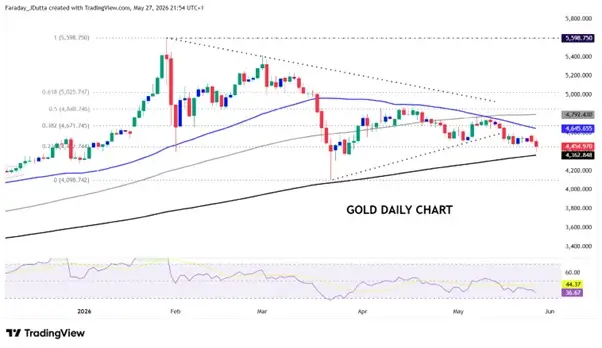
Gold slid as it broke down out of its recent range and headed towards the 200-day SMA at $4,362. See below for more.
Day Ahead – US Core PCE
The Fed’s favoured inflation gauge is predicted to rise 0.3% m/m and 3.3% y/y. The annual print remains firm and the highest reading since January 2024, aligning with a trend that runs well above the central bank’s 2% target. That means the Fed’s inflation problem is persisting and will become worse if oil prices remain continually elevated. Indeed, the April FOMC meeting minutes highlighted a clear lack of appetite among policymakers for rate cuts this year and even that a majority would support rate hikes if core inflation remained above target into the second half of this year. Middle East tensions, higher energy prices, AI-driven demand and resilient labour markets were all cited.
There’s currently near a coin flip chance of a 25bps rate hike by year-end, which has been reduced from above 70% last week. Recent falling crude oil prices have helped reduce bets on policy tightening. A firmer PCE print would likely reinforce the higher for longer rates narrative and could recement those arguments for rate hikes. This should keep the dollar supported into the mid-June FOMC meeting, although the wild card will be what new Fed Chair Warsh makes of this. He’s meant to be a dove, but it’s likely he won’t be able to be too dovish too early in his tenure as that risks undermining the long end of the bond market.
Chart of the Day – Gold breakdown?
Gold was soft as it looked to be breaking down from recent sideways trade. We’ve not had a longer losing streak than four days since late March when prices spiked down to $4,098. Price action does look vulnerable following the break of the $4,500 mark and the move out of the major long-term triangle.
The dip now threatens the 200-day SMA at $4,362, an indicator that has not been breached since November 2023 and supported prices on the March spike low. The descending triangle offers a measured move target of roughly $800 lower from current levels. Prices have remained under pressure from elevated inflation expectations linked to higher energy prices, reducing the likelihood of near‑term rate cuts. A confirmed peace deal could potentially support bugs.